




What's Happening?
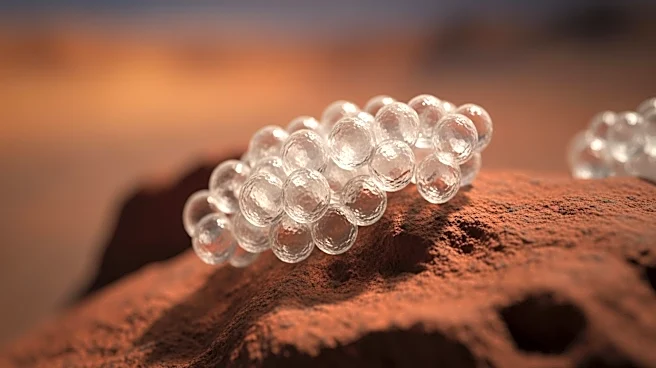
Researchers have conducted experiments using Saccharomyces cerevisiae, a type of yeast, to simulate the harsh conditions on Mars, including shock waves from meteorite impacts and the presence of toxic perchlorates in the soil. The study aimed to understand
how life might endure such extreme environments. The yeast cells were exposed to shock waves and perchlorates, conditions that mimic those on Mars. Despite these challenges, the yeast cells survived, demonstrating the formation of protective ribonucleoprotein (RNP) condensates, which help safeguard genetic material and regulate stress responses. This research highlights the resilience of simple life forms and their potential to survive in extraterrestrial environments.
Why It's Important?
The findings from this study are significant for astrobiology and the search for life beyond Earth. By demonstrating that simple organisms like yeast can survive Mars-like conditions, scientists gain valuable insights into the potential for life to exist on other planets. The study underscores the importance of RNP condensates as a survival mechanism, which could inform future research on the adaptability of life in extreme environments. This research also contributes to our understanding of how life on Earth might have originated and adapted to harsh conditions, providing a model for studying life's potential on other planets.
What's Next?
Future research will likely focus on exploring other simple organisms and their ability to withstand extraterrestrial conditions. Scientists may also investigate the genetic and molecular mechanisms that enable these organisms to survive, which could lead to advancements in biotechnology and space exploration. The development of new technologies to simulate extraterrestrial environments more accurately will enhance our understanding of life's potential beyond Earth. Additionally, these findings may inform the design of life-detection experiments for future Mars missions, helping to refine the search for extraterrestrial life.