



What's Happening?
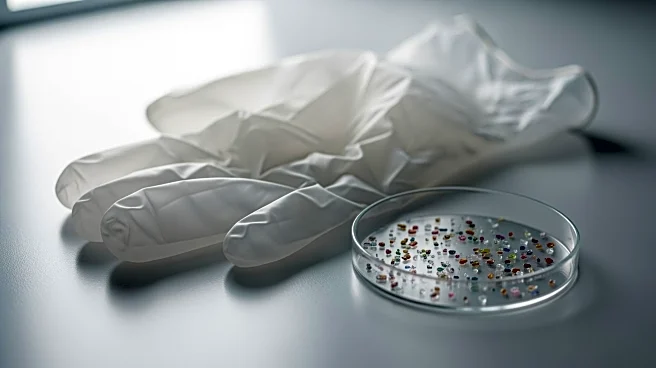
A study conducted by researchers at the University of Michigan has uncovered that nitrile and latex gloves, commonly used in scientific laboratories, may be contributing to inflated microplastics data. The research, led by Madeline Clough and Anne McNeil,
found that these gloves can transfer particles onto lab tools used for analyzing environmental samples, such as air and water. These particles, known as stearates, are not plastics but can mimic them during testing, leading to potential false positives in microplastics research. The study suggests that using cleanroom gloves, which release fewer particles, could mitigate this issue. The findings were published in RSC Analytical Methods and highlight the need for careful consideration of lab materials in microplastics research.
Why It's Important?
The discovery has significant implications for the field of environmental science, particularly in the study of microplastics. Accurate data is crucial for understanding the extent of microplastic pollution and its impact on ecosystems and human health. If microplastics levels are overestimated due to contamination from lab gloves, it could lead to misguided policy decisions and resource allocation. The study emphasizes the importance of using appropriate lab materials to ensure the reliability of scientific data. This revelation could prompt a reevaluation of past research findings and influence future studies, potentially leading to more accurate assessments of microplastic pollution.
What's Next?
Following this study, researchers may need to revisit previous datasets to correct for potential contamination from lab gloves. The development of new methods to distinguish between real microplastics and glove-related particles could aid in this process. Additionally, the scientific community might adopt new standards for lab practices, such as the use of cleanroom gloves, to prevent similar issues in future research. This could also lead to increased collaboration between chemists and environmental scientists to enhance the accuracy of microplastics studies.