






What's Happening?
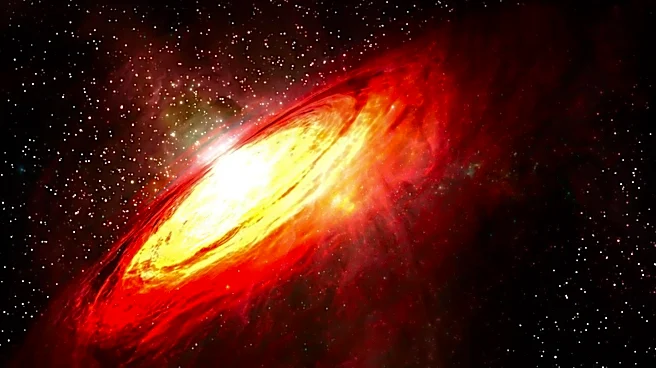
The European Space Agency's (ESA) Euclid Space Telescope, with contributions from NASA, has discovered 31 of the oldest quasars ever documented, including two that are the oldest ever observed. These quasars date back to the universe's infancy, when it was
just 5% of its current age. Quasars are formed when immense amounts of gas and dust fall into a supermassive black hole, generating enormous energy and luminosity. The Euclid mission is imaging billions of galaxies to improve understanding of 'dark energy,' the phenomenon causing the universe to expand at an accelerating rate. These findings will inform future missions, such as NASA's Nancy Grace Roman Space Telescope, which aims to further explore dark energy.
Why It's Important?
The discovery of these ancient quasars is significant as it provides insights into the early universe and the formation of galaxies and black holes. Understanding dark energy is crucial because it influences the universe's expansion and large-scale structure. The Euclid mission's findings could reshape our comprehension of cosmic evolution and inform future astronomical research. This research has the potential to impact theoretical physics and cosmology, offering a deeper understanding of the universe's fundamental forces and components.
What's Next?
The Euclid mission will continue to image billions of galaxies, enhancing our understanding of dark energy. The data collected will support the development of NASA's Nancy Grace Roman Space Telescope, scheduled to launch in the coming years. This telescope will provide more detailed observations of dark energy, furthering our knowledge of the universe's expansion. The collaboration between ESA and NASA highlights the importance of international cooperation in space exploration, paving the way for future joint missions and discoveries.