





What's Happening?
A team led by the University of Warwick has developed a unified approach to identify spacetime fluctuations, which are tiny, random distortions in spacetime structure. These fluctuations are predicted by various quantum gravity theories but have been
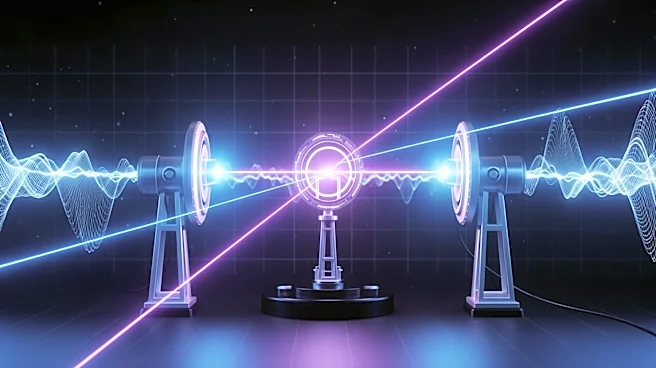
difficult to detect due to differing predictions. The research categorizes these fluctuations into three main types, each with measurable patterns detectable by laser interferometers like LIGO. This approach allows for testing a range of quantum-gravity predictions using existing technology, potentially advancing the understanding of quantum physics and gravity.
Why It's Important?
This development is significant as it provides a method to test quantum gravity theories, a major goal in physics. Understanding spacetime fluctuations could bridge the gap between quantum mechanics and general relativity, two fundamental yet currently incompatible theories. The ability to detect these fluctuations could lead to breakthroughs in understanding the universe's fundamental nature, impacting fields such as cosmology and particle physics. The research also highlights the potential of existing technology to explore new scientific frontiers, emphasizing the importance of innovative approaches in scientific discovery.
What's Next?
The methodology developed by the researchers will be used to design more advanced interferometers to test quantum gravity theories further. This could lead to new experiments and collaborations aimed at exploring the fundamental nature of spacetime. The research may also inspire similar approaches in other areas of physics, potentially leading to new discoveries about the universe's structure and the forces that govern it.