






What's Happening?
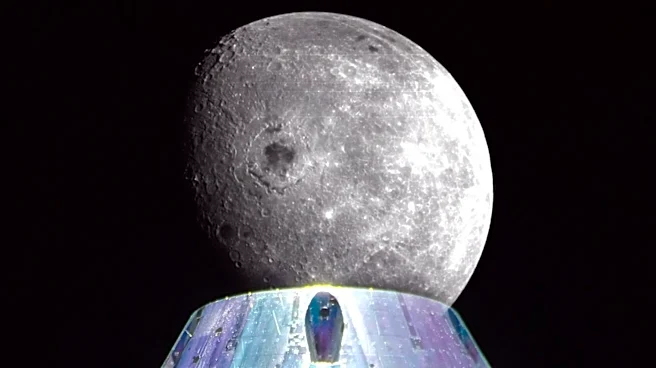
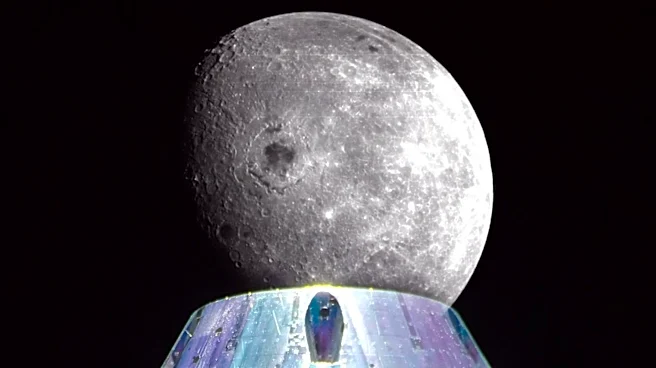
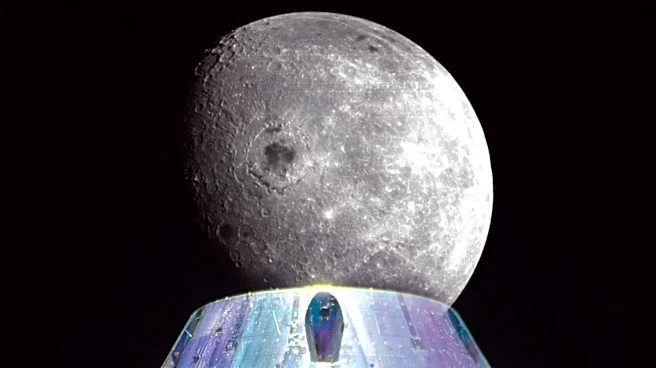
NASA announced accelerated plans for its Artemis program, aiming to return Americans to the lunar surface by 2028. This includes advancing the Artemis III test flight to 2027 and the Artemis IV Moon landing mission to 2028. NASA Administrator Jared Isaacman
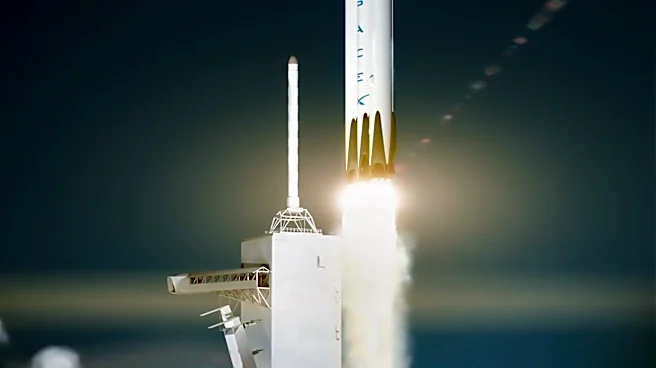
highlighted significant progress in collaboration with industry partners to test critical capabilities and reduce risks. For Artemis III, four astronauts will fly aboard the Orion spacecraft, launched by NASA’s SLS rocket, for a 14-day Earth orbit mission to test rendezvous, docking, and operations with lunar lander test vehicles from SpaceX and Blue Origin. NASA also revealed plans with Axiom Space to develop a lighter 'Sortie suit' for initial moonwalks, which is roughly half the weight of Axiom’s primary suit and designed to expedite early surface missions.
Why It's Important?
This acceleration of the Artemis program signifies a renewed U.S. commitment to lunar exploration and establishing a sustained human presence on the Moon. The collaboration with private companies like SpaceX, Blue Origin, and Axiom Space is crucial, demonstrating a shift towards public-private partnerships to achieve ambitious space goals. This approach aims to leverage commercial innovation, potentially reducing costs and accelerating development timelines. The development of new lunar landers and specialized spacesuits is vital for ensuring the safety and success of future missions, impacting U.S. leadership in space technology and exploration. The program also aims to provide economic benefits and advance scientific discovery, laying the groundwork for future crewed missions to Mars.
What's Next?
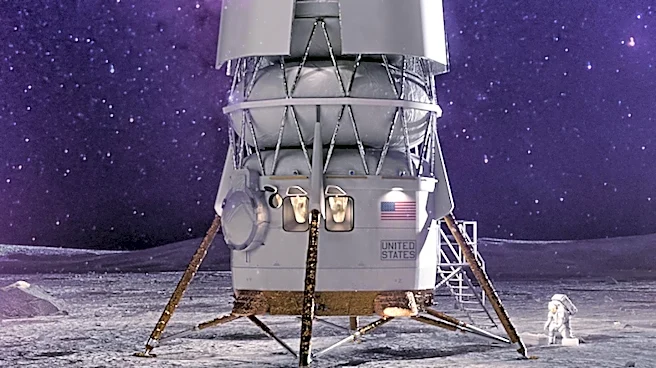
The Artemis III mission is scheduled for a test flight in 2027, involving complex orbital maneuvers and docking procedures with test articles from Blue Origin and SpaceX. The Artemis IV Moon landing mission is targeted for 2028, with both SpaceX and Blue Origin developing lunar landers to transport astronauts to the Moon's surface. NASA is also pursuing two upper-stage options for the SLS rocket to maintain flexibility and prevent single-point dependency. The development of the 'Sortie suit' by Axiom Space will continue, with the goal of enabling the first moonwalks. These steps are part of a broader strategy to establish an enduring human presence at the lunar South Pole and prepare for future deep-space exploration.
Beyond the Headlines
The accelerated Artemis program reflects a strategic imperative for the U.S. to maintain its leadership in space exploration, especially in the face of growing international competition. The emphasis on public-private partnerships could redefine the future of space travel, making it more accessible and commercially viable. The technological advancements driven by this program, such as new spacesuit designs and lunar lander capabilities, could have broader applications beyond space, influencing fields like robotics, materials science, and extreme environment engineering. Furthermore, establishing a sustained human presence on the Moon could unlock new scientific discoveries, resource utilization opportunities, and serve as a critical stepping stone for humanity's expansion into the solar system.