







What's Happening?
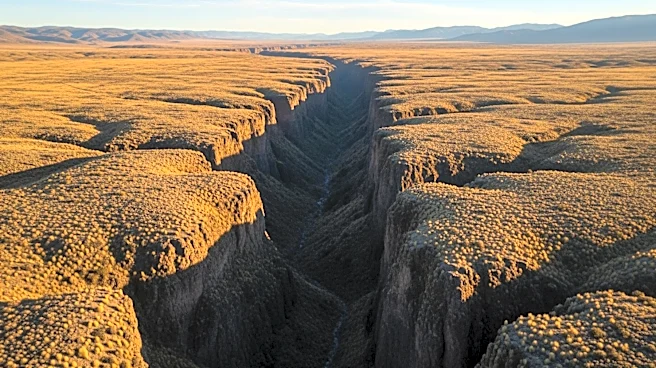
A team led by Mike Daly, a professor of earth sciences at the University of Oxford, has discovered evidence of an active rift in Zambia that could potentially lead to the continent splitting. The Kafue Rift, a long crack in the Earth's crust, has shown
signs of activity through the detection of deep mantle gases in hot spring water. This discovery was made by analyzing gas samples from geothermal wells and springs, revealing a clear mantle component in the gases from the rift zone. The findings suggest that the rift is part of the Southwest African Rift, which stretches from Tanzania to Namibia, and could eventually form a new plate boundary.
Why It's Important?
The identification of an active rift in Zambia has significant implications for both geological understanding and resource exploration. If the rift continues to develop, it could lead to Africa splitting along a new plate boundary, altering the continent's geography. Additionally, early-stage rifts like the Kafue Rift can produce geothermal heat and pockets of helium and hydrogen, which are valuable resources. Helium is in demand for medical scanners and microchips, while hydrogen is sought as a clean fuel. The discovery enhances the prospects for local power generation and resource extraction, potentially benefiting Zambia's economy.
What's Next?
Further fieldwork is underway along the Southwest African Rift, including segments in Botswana and Namibia, to confirm the extent of the rift's activity. Results from these studies are expected later this year, which could provide more insights into the potential for Africa's continental split. The findings may also influence energy exploration strategies in the region, as the presence of geothermal heat and rare gases could attract investment in resource development.
Beyond the Headlines
The study shifts the focus from the East African Rift, traditionally considered the likely site for Africa's continental break, to Zambia as a serious candidate for a new plate boundary. This could change the narrative around Africa's geological future and highlight the importance of geochemical analysis in understanding Earth's processes. The research also underscores the potential for early-stage rifts to contribute to sustainable energy solutions, aligning with global efforts to transition to cleaner energy sources.