



What's Happening?
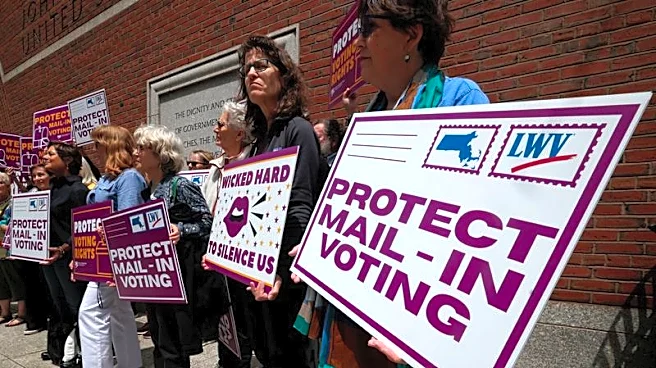
A federal judge has once again blocked the President Trump administration's plan to regulate mail-in voting, issuing an injunction that deems the new postal service rule for sending mail-in ballots likely unlawful and unconstitutional. This ruling comes
after an Executive Order issued in March aimed to modify the vote-by-mail system to ensure only U.S. citizens cast ballots. The order would have required mail-in ballots to feature a unique barcode for voter identification and would have allowed the U.S. Postal Service to reject ballots from states not complying with these requirements. Pima County Recorder Gabriella Cázares-Kelly stated that Pima County already meets these requirements, but expressed concern that other Arizona counties lack the resources to comply. She also noted that a mandated online portal for local election officials to upload early voter names and addresses has not yet been launched, nor has any information about it been provided.
Why It's Important?
This judicial intervention is highly significant for the integrity and accessibility of U.S. elections, particularly for the upcoming midterm elections. With approximately 80% of Arizona voters utilizing mail-in ballots, any changes to the system could profoundly impact voter participation and trust. Pima County Recorder Cázares-Kelly highlighted that the ongoing legal battle is causing fear and an increase in voter inquiries, suggesting a potential destabilization of early voting. The injunction provides temporary relief, preventing immediate changes that could disenfranchise voters or create logistical chaos for election officials. The disparity in resources among Arizona counties to meet the proposed requirements underscores a broader challenge in implementing uniform election standards across diverse jurisdictions. This situation also emphasizes the critical role of the judiciary in safeguarding electoral processes against executive overreach and ensuring constitutional compliance.
What's Next?
As the legal battle continues, Pima County election officials are proceeding with business as usual, preparing to send out the first batch of ballots to overseas and military voters in less than two weeks, followed by over half a million ballots for early voting on October 7. The federal judge's injunction means that, for now, the midterm elections will move forward without the changes proposed by the President Trump administration's Executive Order. However, the long-term legal status of the order remains uncertain, and further appeals or legal challenges could arise. Pima County Recorder Cázares-Kelly encourages voters to verify their registration and ensure their ballot information is current via the Pima County Recorder’s website. The general election is scheduled for November 3. The ongoing legal dispute will likely continue to be a focal point, potentially influencing voter confidence and participation in future elections, regardless of the final judicial outcome.
Beyond the Headlines
This development delves into the fundamental principles of democratic governance and the balance of power between the executive and judicial branches. The President Trump administration's attempt to regulate mail-in voting, ostensibly to ensure only U.S. citizens vote, raises deeper questions about voter access, election security, and the potential for partisan manipulation of electoral processes. The concerns voiced by election officials like Cázares-Kelly about the lack of consultation and the timing of such significant changes highlight the practical challenges of implementing top-down mandates without understanding local operational realities. This situation also underscores the broader political polarization surrounding voting methods, with mail-in voting becoming a contentious issue. The impact on voter confidence, even if the order is ultimately struck down, could be long-lasting, potentially fostering distrust in the electoral system. This case serves as a critical examination of how policy decisions, even those framed as enhancing security, can inadvertently create barriers to participation and erode public faith in democratic institutions.