
What's Happening?
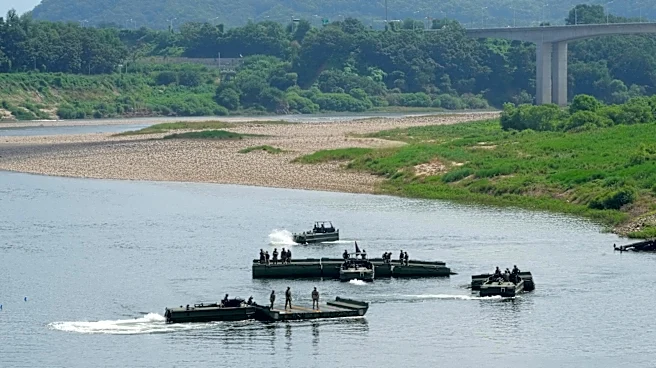
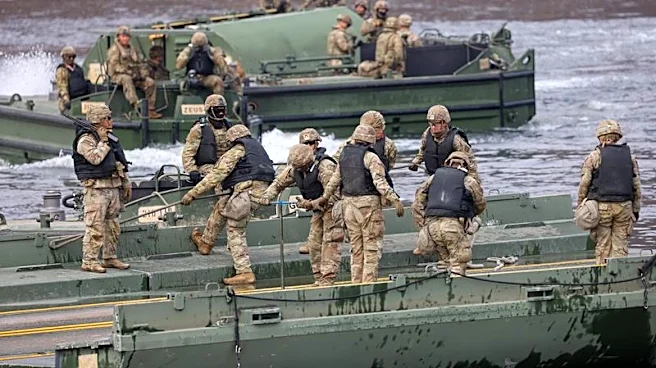
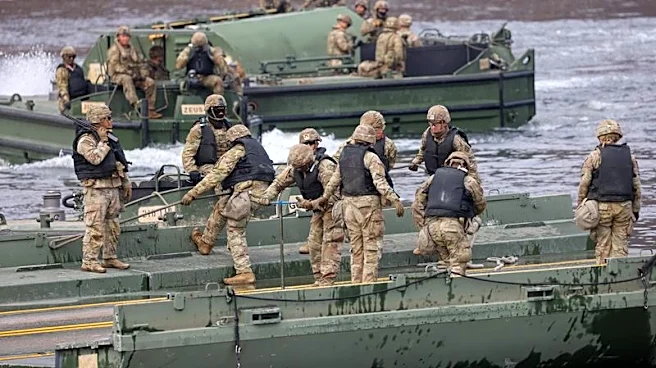
President Trump has directed the Pentagon to scale back joint military exercises with South Korea. This decision comes as President Trump criticizes South Korea for what he perceives as insufficient support
in the ongoing conflict with Iran and for not contributing enough financially to its own defense. He stated that the U.S. cannot protect countries that are not willing to help. This move follows similar allegations against other U.S. allies, including members of NATO, regarding their defense spending and support for U.S. military initiatives. Concurrently, President Trump has made public overtures to North Korean leader Kim Jong Un, posting a photo of them together in the Demilitarized Zone and expressing a desire to re-engage in denuclearization talks. The South Korean Embassy in Washington has stated it is coordinating closely with the U.S. on the exercises, while Foreign Minister Cho Hyun indicated that Seoul was not notified in advance of President Trump's order to reduce the drills.
Why It's Important?
This decision carries significant implications for U.S. alliances and regional stability in East Asia. Scaling back joint military exercises could be seen as undermining South Korea's defense posture, especially given the ongoing tensions with North Korea. Experts like Retired Rear Adm. Mark Montgomery view President Trump's actions as 'befuddling and illogical,' questioning the strategy of punishing an ally while reaching out to an adversary. The move could also signal a shift in U.S. foreign policy, where military support for allies becomes increasingly conditional on their direct contributions to U.S. military campaigns and financial commitments. This could lead to a re-evaluation of security agreements and burden-sharing among U.S. allies globally, potentially weakening established alliances and creating uncertainty in international relations. The outreach to Kim Jong Un, while potentially aimed at denuclearization, risks alienating South Korea and Japan, who rely on the U.S. security umbrella.
What's Next?
The immediate next steps involve ongoing consultations between the U.S. and South Korea regarding the reduced military exercises. South Korean Defense Minister Ahn Gyu-back is reportedly in close discussions with U.S. counterparts. Foreign Minister Cho Hyun has expressed hope that the friendly relationship between President Trump and Kim Jong Un could lead to meaningful dialogue for peace and stability on the Korean Peninsula, and Seoul is preparing to open channels for dialogue with North Korea. However, the lack of prior notification to South Korea about the exercise reduction suggests potential friction in the alliance. Regional experts will be closely watching for any progress in denuclearization talks between the U.S. and North Korea, as well as the reactions from other U.S. allies who may feel similarly pressured to increase their contributions or support U.S. military endeavors. The long-term implications for the U.S.-South Korea alliance and the broader security architecture in Asia remain to be seen.
Beyond the Headlines
Beyond the immediate military and diplomatic implications, President Trump's actions highlight a deeper philosophical shift in U.S. foreign policy regarding alliances. His emphasis on financial contributions and direct support for U.S. military operations, rather than a broader strategic partnership, challenges the traditional post-World War II framework of collective security. This approach could lead to a more transactional model of international relations, where alliances are viewed through a cost-benefit lens. The potential for the U.S. to sideline allies in pursuit of direct negotiations with adversaries, as suggested by some experts regarding North Korea, raises ethical questions about loyalty and trust in international diplomacy. Furthermore, the focus on 'fairness' in defense spending could set a precedent for future demands on other allies, potentially reshaping global power dynamics and the role of the U.S. as a global leader. The long-term impact on regional stability and the proliferation of nuclear weapons will be a critical area to monitor.