







What's Happening?
The United States has committed more than $44 million in new security programming for the Pacific region. This funding, announced at the inaugural U.S.-Pacific Islands Conference of Police Ministers in Los Angeles, aims to counter a connected criminal
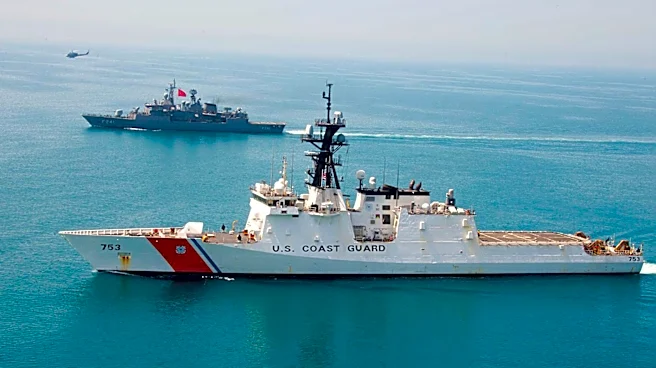
network involved in narcotics trafficking and money laundering across the Pacific. Key initiatives include establishing a maritime law enforcement center in Palau, expanding patrol cooperation, and providing new border-screening equipment for Tonga. The U.S. State Department highlighted that precursor chemicals reach clandestine laboratories in Mexico, Colombia, Ecuador, and Southeast Asia, with finished drugs then transported across the Pacific. Since 2024, narcotics trafficked through the Pacific by Western Hemisphere cartels have surpassed flows from Asia. The comprehensive package spans maritime surveillance, police investigations, port security, and financial-crime enforcement, emphasizing that enforcement must begin where drugs and precursor chemicals enter legitimate trade.
Why It's Important?
This significant investment underscores the U.S.'s strategic interest in enhancing security and stability in the Pacific, directly impacting the American homeland by disrupting transnational criminal operations. The funding targets a critical vulnerability in the global drug trade, where cartels utilize Pacific routes for trafficking and money laundering. By strengthening law enforcement capabilities in Pacific Island nations, the U.S. aims to create a more secure environment, reducing the flow of illicit drugs and associated criminal activities that can destabilize regions and pose threats to U.S. national security. The initiative also fosters stronger diplomatic ties and cooperation with Pacific partners, aligning with broader U.S. foreign policy objectives in the Indo-Pacific. The focus on maritime surveillance and port security is crucial for interdicting drug shipments and combating illegal fishing, which often intertwines with organized crime.
What's Next?
The U.S. plans to invest $7 million in a regional maritime law enforcement training and coordination center in Palau, which will serve as the headquarters for the Aumoana Regional Law Enforcement Initiative. This center will train Pacific personnel in vessel boarding, evidence handling, and maritime awareness, and host U.S. and regional liaison officers for intelligence support. A separate $5.5 million package will enhance maritime awareness, providing surveillance tools for the Pacific Islands Forum Fisheries Agency and Fiji’s maritime services, and a secure communications system for the Samoa-hosted Pacific Transnational Crime Coordination Centre. The State Department will also equip four Papua New Guinea National Fisheries Authority patrol boats with advanced cameras and radar. Additionally, Tonga will receive about $3.5 million for border detection, including cargo-screening equipment and support for canine-detection kennels. The FBI will provide $5 million for Pacific police investigations into drug trafficking, bribery, money laundering, and cybercrime, with training and liaison support extending into 2027 and beyond.
Beyond the Headlines
The U.S. initiative extends beyond immediate law enforcement, aiming to build long-term institutional capacity and foster regional self-sufficiency in combating transnational crime. By investing in training, equipment, and intelligence sharing, the program seeks to empower Pacific Island nations to independently address complex criminal challenges. This approach recognizes that effective security is not merely about interdiction but also about strengthening governance, rule of law, and economic resilience. The focus on financial intelligence and cybercrime units, including training in cryptocurrency tracing, highlights an adaptation to evolving criminal methodologies. The commitment to supporting these efforts into 2027 and beyond suggests a sustained, multi-year strategy, indicating a deeper engagement with Pacific partners to counter the multifaceted threats posed by organized crime and ensure regional stability.