
What's Happening?
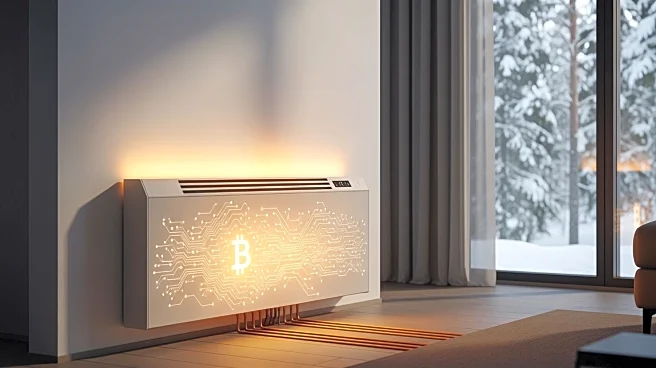
In Finland, a novel approach to heating homes is being implemented by utilizing waste heat from bitcoin mining operations. Matt Carlsson, who previously worked in energy efficiency, has joined MARA Holdings,
a bitcoin mining company, to help heat the homes of 80,000 residents using the excess heat generated from cryptocurrency mining. This process involves water running through the mining units, which are cooled and then used to heat water that is pumped through existing district heating systems. This initiative has significantly reduced the need for traditional boilers and has avoided greenhouse gas emissions equivalent to those produced by 700 U.S. homes since its inception in 2024. The project is part of a broader trend in Finland, where several companies are integrating bitcoin mining with district heating systems to improve energy efficiency and sustainability.
Why It's Important?
This development is significant as it presents a dual benefit of reducing carbon emissions while providing a cost-effective heating solution. By repurposing the waste heat from bitcoin mining, MARA Holdings and similar companies are able to offer a sustainable alternative to traditional heating methods, which often rely on burning biomass or fossil fuels. This approach not only helps in mitigating climate change by reducing reliance on carbon-emitting energy sources but also provides economic resilience for bitcoin mining companies. They can generate revenue from both cryptocurrency and heating services, insulating them from fluctuations in bitcoin prices. This model could potentially be expanded globally, offering a sustainable solution in regions with similar infrastructure and climate conditions.
What's Next?
The success of this initiative in Finland could inspire other countries to adopt similar models, especially those with existing district heating systems. However, the scalability of this solution may be limited by the efficiency of current district heating systems and the availability of infrastructure to support such integration. Additionally, while this model offers a temporary solution, there is ongoing debate about the overall environmental impact of bitcoin mining, which remains energy-intensive. Future developments may focus on improving the energy efficiency of bitcoin mining or transitioning to less energy-intensive methods of cryptocurrency verification.
Beyond the Headlines
The integration of bitcoin mining with district heating systems raises questions about the long-term sustainability of such practices. While it offers immediate benefits in terms of reduced emissions and energy costs, the reliance on bitcoin mining, which is inherently energy-intensive, may not align with broader decarbonization goals. Environmental advocates argue for a shift in cryptocurrency verification methods to reduce energy consumption. Additionally, the economic viability of this model is contingent on the stability of bitcoin prices and the continued demand for cryptocurrency. As such, while this initiative represents a creative use of waste heat, it may not be a comprehensive solution to energy and environmental challenges.