







What's Happening?
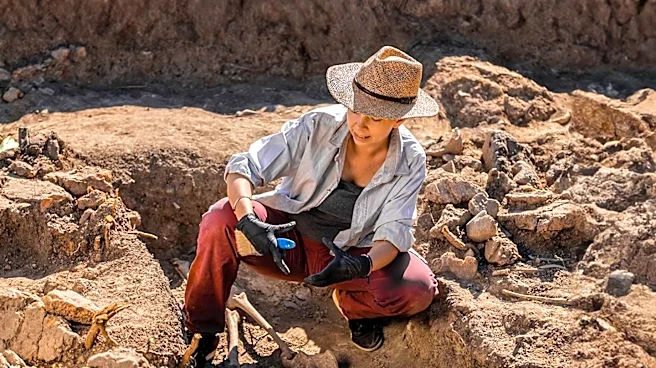
Researchers are re-examining the 17th-century burial of a woman in Pień, Poland, who was interred with a sickle across her neck and a padlock on her toe, measures believed to prevent her from rising from the grave as a 'vampire.' The woman, named Zosia
by archaeologists, was approximately 18 years old and exhibited several unusual physical characteristics, including Kimmerle anomaly, Harris lines, and a growth on her breastbone. These conditions may have made her appear different to her contemporaries, leading to suspicion. The burial itself was unusual, suggesting it occurred in two stages, with the grave being reopened to place the sickle. Despite the harsh treatment, delicate silk fibers with silver and gold threads found near her skull indicate she may have been from a wealthy family. The cemetery in Pień appears to have been an unconsecrated burial ground for the poor, disgraced, or excluded, raising questions about Zosia's social standing and why she was buried there. Chemical analysis of her teeth suggests she may have grown up in various European regions, potentially making her a foreigner in 17th-century Poland, a time of military conflict between Sweden and Poland.
Why It's Important?
This re-examination offers significant insights into the social fears, medical understanding, and burial practices of 17th-century Poland. It highlights how physical differences and foreign origins could lead to ostracization and extreme measures, even in death. The discovery of other unusual burials in the same cemetery, including children, indicates a widespread 'vampire hysteria' across Eastern and Central Europe. This historical context is crucial for understanding the cultural anxieties of the period and how communities dealt with perceived threats, whether real or imagined. The advanced forensic work, including facial reconstruction, not only brings Zosia's story to life but also underscores the power of modern archaeology to shed light on individual lives within broader historical narratives. The contrast between the efforts to keep her buried and the modern scientific endeavor to understand her life and death provides a compelling narrative about human perception and scientific inquiry.
What's Next?
Researchers will likely continue to analyze Zosia's remains and the other unusual burials found in the Pień cemetery to gather more data on 17th-century Polish society and its beliefs. Further chemical analyses could provide more precise details about her origins and diet. The ongoing study of the other graves with similar 'anti-vampire' measures will help to build a more comprehensive picture of the extent and nature of this hysteria. The findings may also contribute to broader discussions in historical anthropology and folklore studies regarding the origins and evolution of vampire myths and the societal factors that fueled such fears. The facial reconstruction of Zosia may lead to public exhibitions or educational programs, further engaging the public with this unique historical discovery.
Beyond the Headlines
The story of Zosia transcends a mere archaeological discovery; it delves into the profound human tendency to fear and demonize the 'other.' Her physical anomalies, combined with potential foreign origins and wealth, made her a target for suspicion in a superstitious era. This narrative serves as a powerful historical parallel to contemporary issues of prejudice and misunderstanding towards individuals who are perceived as different. It highlights how a lack of scientific understanding can lead to irrational fears and severe social consequences. The meticulous efforts to prevent her return, contrasted with modern efforts to understand her, underscore a fundamental shift in human inquiry from superstition to scientific investigation. The ethical implications of such historical treatment of the deceased also prompt reflection on how societies treat their marginalized members, both historically and in the present day.