



What's Happening?
A caver in Central Texas has discovered a significant collection of Ice Age fossils, including mastodons, mammoths, saber-toothed cats, and a lion-sized armadillo relative. The discovery was made in Bender’s Cave in Comal County, where fossils were found
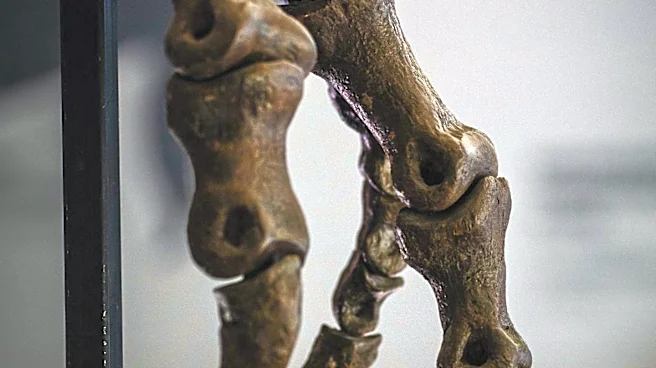
lying on the streambed. Palaeontologist John Moretti from the University of Texas at Austin, along with the caver John Young, conducted the first palaeontological study of a Texas water cave based on this find. The collection includes common Ice Age animals like mammoth calves, bison, and horses, as well as rarer finds such as Jefferson’s ground sloth and a mastodon, represented by a single molar fragment. Uniquely, the site also yielded a shoulder blade from a giant tortoise (Hesperotestudo) and body armor from a pampathere (Holmesina septentrionalis), an armadillo relative previously unrecorded on the Edwards Plateau. Unlike typical fossil sites requiring extensive excavation, these specimens were easily accessible, resting on the cave floor for millennia.
Why It's Important?
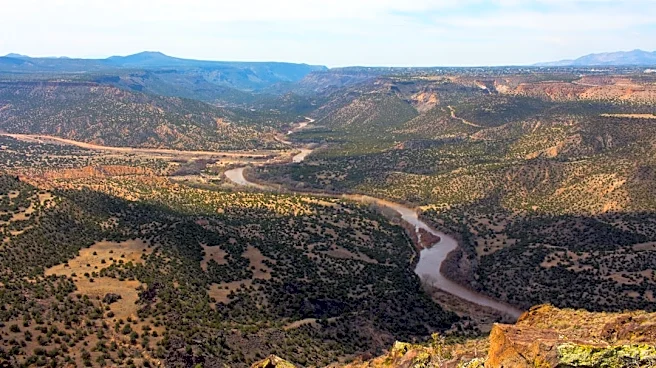
This discovery is important for understanding the prehistoric ecology of Central Texas, particularly the Edwards Plateau. The presence of species like giant tortoises and pampatheres, which prefer warm, damp environments, alongside browsers like ground sloths and mastodons, suggests a different climate than previously understood for the region during the late Pleistocene. Existing studies of 17 other late Pleistocene sites on the plateau describe a cool, dry, open grassland, contrasting sharply with the findings in Bender's Cave. This discrepancy leads to the hypothesis that the fossil assemblage may date to a warm interglacial period, possibly 130,000 to 71,000 years ago, well before the last glacial maximum. If confirmed, this would open a new window into a previously unobserved ancient landscape in this part of Texas, challenging current palaeontological models and providing crucial data for climate scientists studying past environmental shifts. The ease of access to these fossils also highlights the potential for similar undiscovered sites in the numerous water caves of Central Texas.
What's Next?
Researchers are facing challenges in accurately dating the fossils. Two bone samples sent for radiocarbon dating lacked collagen, and a third yielded an uninterpretable age due to modern carbon contamination from the cave's calcite-rich groundwater. To overcome this, the team plans to use uranium-series dating on calcite crusts found around the fossils and a combined uranium and electron spin resonance technique on mammal teeth. These advanced dating methods aim to provide a more precise timeline for the fossil assemblage. Additionally, the presence of a 20th-century rubbish pit scattering modern debris among the Pleistocene material indicates the need for careful analysis to distinguish between different time periods. The ongoing research will focus on proving the hypothesis of a warm interglacial period, which could significantly alter the understanding of Texas's ancient climate and biodiversity. The study also underscores the potential for further palaeontological exploration in the region's water caves.
Beyond the Headlines
The discovery in Bender's Cave transcends a mere collection of ancient bones; it offers a profound glimpse into the dynamic nature of Earth's climate and its impact on ecosystems over vast timescales. The unexpected presence of warm-climate species in a region currently characterized by different ecological conditions highlights the dramatic climatic fluctuations that have shaped North America. This finding could influence how scientists model future climate change scenarios, providing empirical evidence of significant environmental shifts. Furthermore, the unique preservation conditions, with fossils lying exposed on a streambed, challenge conventional archaeological and palaeontological methods, suggesting that valuable data might exist in previously overlooked or inaccessible environments. The ethical implications of exploring such pristine and fragile natural archives also come to the forefront, emphasizing the need for careful scientific practice and conservation efforts to protect these irreplaceable records of the past.