
What's Happening?
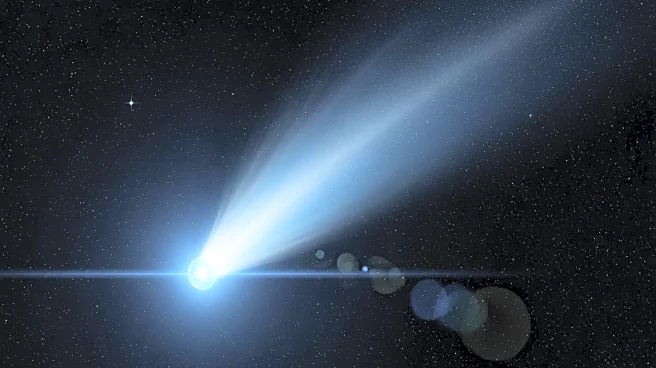
The interstellar comet 3I/Atlas is making its closest approach to Earth this week, providing a rare opportunity for scientific study. Discovered in July 2025, 3I/Atlas is the third known interstellar object
to enter our solar system. NASA has confirmed it as a comet, despite initial speculations about its nature. The comet, originating from outside the solar system, will pass within 167 million miles of Earth on December 19, 2025. NASA and other scientific teams are utilizing various instruments to gather data on the comet's composition and trajectory, aiming to learn more about its origins and characteristics.
Why It's Important?
The passage of 3I/Atlas offers a unique chance to study an interstellar object, providing insights into the composition and behavior of celestial bodies from beyond our solar system. This event could enhance understanding of cometary science and the processes that govern the movement of interstellar objects. The data collected may also contribute to broader astronomical research, potentially revealing information about the conditions and materials present in other star systems. The study of 3I/Atlas underscores the importance of international collaboration in space exploration and the role of advanced technology in expanding human knowledge of the universe.
What's Next?
Following its closest approach to Earth, 3I/Atlas will continue its journey through the solar system, heading towards Jupiter and eventually exiting into interstellar space by the mid-2030s. Scientists will continue to monitor the comet, using ground-based telescopes and other observational tools to track its path and gather additional data. The information obtained from 3I/Atlas will be analyzed to improve models of interstellar object behavior and inform future missions aimed at studying similar phenomena.