



What's Happening?
NASA astronauts Christina Koch and Victor Glover, along with Canadian Space Agency astronaut Jeremy Hansen and NASA astronaut Reid Wiseman, are part of the Artemis II mission, which marks the first crewed flight of the Space Launch System rocket and Orion
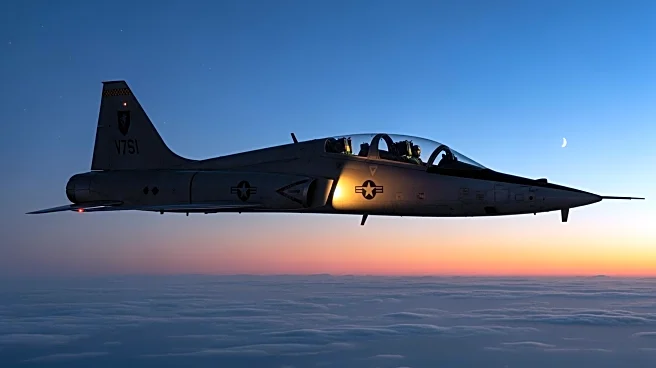
spacecraft. On February 11, 2026, Koch and Hansen participated in a T-38 training flight from Ellington Field, with a waning crescent Moon visible above. This mission is a critical step in NASA's Artemis program, aiming to test the Orion spacecraft's systems and capabilities by flying around the Moon and returning to Earth with a splashdown off the California coast. The Artemis program is part of a broader initiative to advance U.S. crewed missions on the lunar surface, ultimately preparing for future missions to Mars.
Why It's Important?
The Artemis II mission is a pivotal component of NASA's efforts to re-establish a human presence on the Moon and lay the groundwork for future exploration of Mars. By testing the Orion spacecraft's systems in a real-world environment, NASA aims to ensure the safety and reliability of its technology for subsequent missions. This mission represents a significant milestone in the U.S. space program, potentially enhancing the country's leadership in space exploration. The success of Artemis II could lead to increased investment in space technology and inspire a new generation of scientists and engineers. Additionally, the mission underscores international collaboration in space exploration, as evidenced by the involvement of Canadian astronaut Jeremy Hansen.
What's Next?
Following the successful completion of the Artemis II mission, NASA plans to proceed with Artemis III, which aims to land astronauts on the lunar surface for the first time since the Apollo program. This mission will focus on establishing a sustainable human presence on the Moon, serving as a stepping stone for future Mars exploration. The Artemis program's progress will likely influence global space policy and encourage further international partnerships. As NASA continues to develop its lunar exploration capabilities, other countries and private companies may also increase their involvement in space exploration, potentially leading to new technological advancements and economic opportunities.