






What's Happening?
SpaceX's Starlink satellite internet service is being utilized by a diverse group of extreme users across the U.S. to provide high-speed internet access in remote and challenging environments. Storm chaser Reed Timmer uses Starlink to livestream from
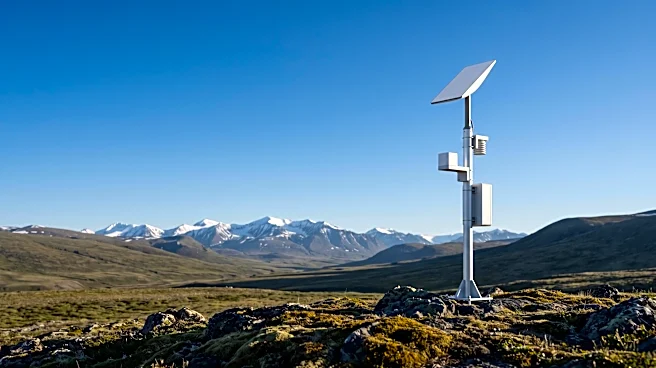
inside tornadoes, providing real-time data that once saved a family from a direct hit in North Dakota. Idaho potato farmer Shane VanOrden employs Starlink-integrated John Deere tractors to maintain connectivity for critical agricultural operations, overcoming rural cellular dead zones and enabling instant data transfers for AutoPath guidance systems. Brendan Hodge, a senior engineer with the EarthScope Consortium, is upgrading hundreds of remote sensor stations across North and Central America, including those monitoring volcanic and seismic activity in Alaska and Yellowstone, with Starlink Mini dishes to enable real-time data collection where traditional connectivity is slow or unavailable. These applications demonstrate Starlink's capability to deliver reliable internet in areas previously considered dead zones.
Why It's Important?
The deployment of Starlink in these extreme U.S. scenarios has significant implications for various sectors. For emergency services and disaster response, as exemplified by Reed Timmer's storm chasing, Starlink provides crucial real-time communication that can save lives and improve situational awareness during natural disasters. In agriculture, the technology is revolutionizing farm management by ensuring continuous connectivity for advanced machinery, leading to increased efficiency and reduced operational costs for farmers like Shane VanOrden. This can enhance food security and modernize farming practices in rural areas. For scientific research, particularly in geophysics and environmental monitoring, Starlink enables the collection of vital real-time data from remote sensors, improving early warning systems for earthquakes and volcanic activity, which can prevent loss of life and infrastructure damage. The ability to connect previously isolated locations fosters economic development and enhances safety across critical U.S. industries.
What's Next?
The continued expansion and refinement of Starlink technology are expected to further integrate into specialized applications across the U.S. Storm chasers like Timmer anticipate building next-generation vehicles capable of withstanding even more severe weather, relying on Starlink for uninterrupted data streams. In agriculture, the success of Starlink-integrated systems on farms suggests a broader adoption of satellite internet for precision agriculture, potentially leading to more widespread use of smart collars for livestock management and other data-intensive farming practices. For scientific monitoring, EarthScope Consortium plans to continue upgrading remote sensor sites with more power-efficient Starlink dishes, potentially replacing older, slower systems entirely. As SpaceX develops more advanced and power-efficient dish models, Starlink's utility in remote and extreme environments is likely to grow, offering solutions for connectivity challenges in various U.S. industries and research fields.
Beyond the Headlines
Beyond the immediate practical benefits, Starlink's widespread adoption in these extreme U.S. contexts highlights a broader shift towards ubiquitous connectivity, even in the most challenging geographical areas. This technological advancement has profound implications for bridging the digital divide in rural and remote parts of the country, ensuring that essential services, economic opportunities, and critical information are accessible to all. The ability to maintain high-speed internet in the eye of a tornado or on a remote Alaskan volcano underscores the increasing reliance on satellite technology for national resilience and scientific progress. Ethically, it raises questions about data privacy and security in these new networks, especially when critical infrastructure or sensitive scientific data is involved. Culturally, it transforms how individuals in isolated professions, from farmers to scientists, interact with their work and the wider world, fostering a new era of interconnectedness and data-driven decision-making across the U.S.