
What's Happening?
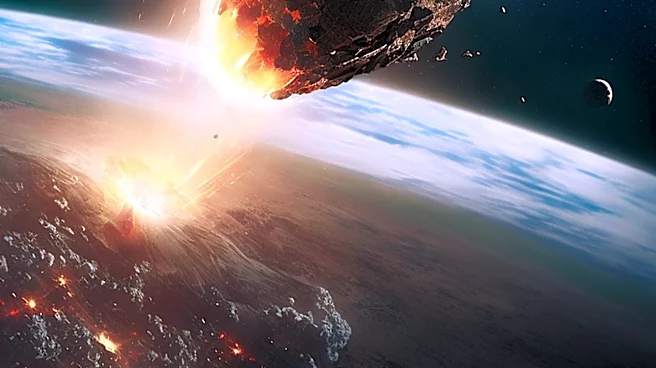
Joël Lapointe, an amateur astronomer, discovered a 390-million-year-old meteorite crater using Google Maps while planning a hiking trip in Québec. The crater, located at specific coordinates, was confirmed
by planetary geologist Gordon Osinski from Canada's Western University, who identified impact melt-rock and shatter cones at the site. These formations are indicative of a meteorite impact. The discovery is set to be presented at the 88th Annual Meteoritical Society Meeting in Germany. Lapointe's find highlights the potential for significant geological discoveries through satellite imagery and the importance of intuition in scientific exploration.
Why It's Important?
This discovery underscores the value of citizen science and the potential for non-experts to contribute to significant scientific findings. The identification of such an ancient crater provides valuable data for understanding Earth's geological history and the impact events that have shaped it. The use of modern technology like Google Maps in scientific discovery also highlights the evolving nature of research methodologies. This finding could inspire further exploration and study of other potential impact sites, contributing to the broader field of planetary science.