
What's Happening?
Researchers have potentially identified a new form of life in the prehistoric organism known as Prototaxites. This organism, which existed around 400 million years ago, has long puzzled scientists due
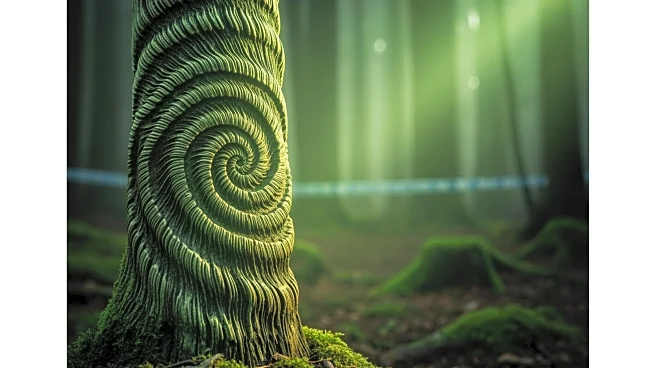
to its unique characteristics that do not fit neatly into existing biological categories such as plants, fungi, or algae. Recent studies, including one published in Science Advances, suggest that Prototaxites may represent an entirely unknown type of multicellular life. The organism's structure, which includes trunk-like formations with concentric rings and a tissue structure similar to fungal mycelium, has led researchers to propose that it consumed organic matter rather than photosynthesizing. This discovery challenges the traditional understanding of life's classification and suggests that Prototaxites could have been the largest terrestrial organism of its time.
Why It's Important?
The identification of Prototaxites as a potential new life form has significant implications for the scientific community. It challenges the current biological classification system, which is based on six kingdoms of life, by suggesting the existence of a seventh, previously unknown category. This discovery could reshape our understanding of evolutionary biology and the history of life on Earth. It also opens new avenues for research into ancient ecosystems and the conditions that allowed such unique organisms to thrive. By expanding the known diversity of life forms, this finding could influence future studies in paleontology, biology, and even astrobiology, as scientists explore the possibility of similar life forms existing elsewhere in the universe.
What's Next?
Future research will likely focus on further analyzing the chemical and structural properties of Prototaxites to confirm its classification as a new life form. Scientists may also investigate the ecological role of Prototaxites in its prehistoric environment and how it interacted with other organisms. This could involve studying similar fossil deposits to find more specimens and gather additional data. The findings could prompt a reevaluation of the evolutionary pathways that led to the development of complex life on Earth. Additionally, researchers may explore the implications of this discovery for understanding the potential for life on other planets, particularly in environments that differ significantly from those on Earth.
Beyond the Headlines
The discovery of Prototaxites as a potential new life form raises questions about the limitations of current scientific methodologies in classifying life. It highlights the need for a more flexible approach to understanding biological diversity, one that can accommodate organisms that do not fit traditional categories. This finding also underscores the importance of interdisciplinary research, as insights from fields such as chemistry, biology, and geology are crucial in piecing together the history of life on Earth. Moreover, the study of Prototaxites could provide valuable lessons for conservation efforts, as understanding ancient ecosystems can inform strategies for preserving biodiversity in the face of modern environmental challenges.