





What's Happening?
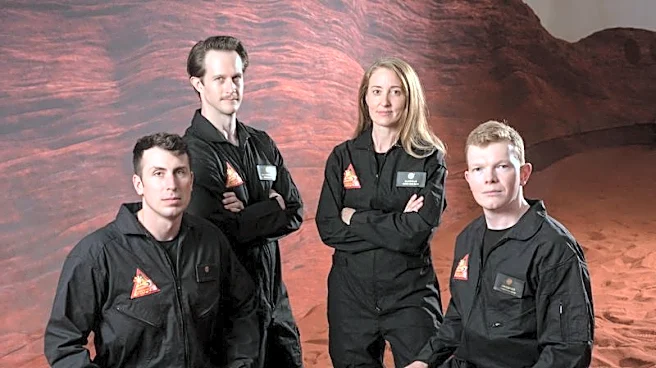
A four-person NASA CHAPEA (Crew Health And Performance Analog Exploration) crew has successfully completed a 378-day simulated mission to Mars, returning to 'Earth' on Halloween. The crew, consisting of James Spicer, Matthew Montgomery, Ellen Ellis, and
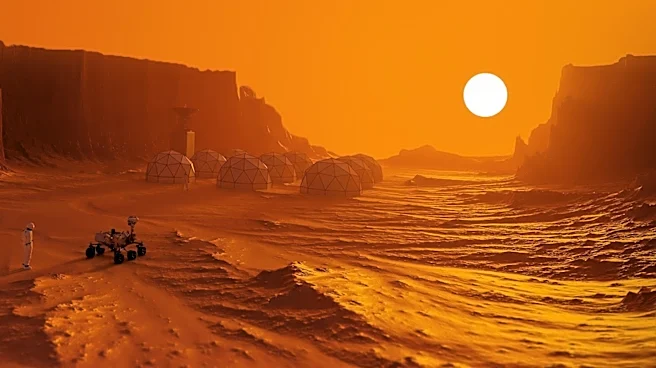
Ross Elder, lived in a 1,700-square-foot 3D-printed habitat designed to replicate the conditions of a Mars mission. During their year-long stay, they conducted spacewalks, grew crops, tested systems, managed limited resources, and experienced communication delays, all while performing extravehicular activities. This mission is part of a series of analog missions aimed at gathering crucial data to inform future planning for actual human missions to the Moon and Mars. The results will help NASA assess the risks associated with planned exploration food systems, crew health and performance, and resource management for long-duration space travel.
Why It's Important?
The CHAPEA mission is vital for understanding the physiological and psychological challenges of long-duration space travel, particularly for future missions to Mars. By simulating a year-long stay in a Mars-like environment, NASA can collect critical data on how humans adapt to isolation, limited resources, and communication delays. This information is essential for designing effective life support systems, crew training protocols, and psychological support mechanisms to ensure the success and safety of astronauts on actual deep-space missions. The insights gained from CHAPEA will directly influence the development of food systems, habitat designs, and operational strategies for future lunar and Martian expeditions, significantly reducing risks and increasing the probability of mission success. It represents a crucial step in preparing humanity for interplanetary travel.
What's Next?
NASA is already planning its next analog mission, which is scheduled to begin no earlier than August 2027. This upcoming mission will integrate elements from both CHAPEA and HERA (Human Exploration Research Analog) missions to simulate various aspects of a mission to the Moon or Mars. The data collected from the recently concluded CHAPEA mission will be analyzed to refine future mission parameters, habitat designs, and crew selection criteria. NASA will continue to seek volunteers for these simulated missions, as ongoing research is necessary to fully understand and mitigate the complex challenges of human deep-space exploration. The findings will directly inform the Artemis program's objectives and the long-term goal of establishing a sustained human presence on Mars.
Beyond the Headlines
The CHAPEA mission delves into the profound human element of space exploration, extending beyond technical challenges to psychological and social dynamics. The experience of prolonged isolation and confinement, even in a simulated environment, offers invaluable insights into human resilience, teamwork, and the potential for conflict or cooperation under extreme stress. This research has implications not only for space travel but also for understanding human behavior in other isolated or high-stress environments on Earth. Ethically, it raises questions about the psychological toll of such missions and the responsibility of space agencies to ensure astronaut well-being. Culturally, these simulations capture the public imagination, bringing the reality of future space travel closer and inspiring discussions about humanity's destiny as a multi-planetary species. The data gathered will contribute to a holistic understanding of what it truly means for humans to live and work far from Earth.