
What's Happening?
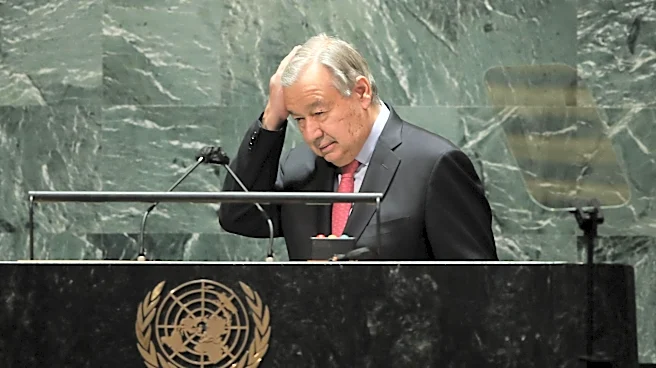
United Nations Secretary-General António Guterres has issued a stark warning regarding global warming, stating that the 2015 Paris Agreement's primary goal of limiting warming to 1.5 degrees Celsius (2.7
degrees Fahrenheit) above pre-industrial levels is no longer attainable. This declaration comes as UN climate talks, COP31, commence in Turkey. Guterres, whose second and final term as UN chief is expiring, emphasized the urgency of the situation, highlighting worsening heat waves, storms, floods, and droughts globally. He revealed that scientists informed him last year that the 1.5°C target was no longer realistic due to the excessive release of carbon dioxide and other greenhouse gases from burning fossil fuels. The UN is now focusing on limiting how much further global temperatures will rise beyond this threshold. Guterres stressed that all nations must do more, and do it now, to address the climate crisis.
Why It's Important?
The UN Secretary-General's announcement that the 1.5°C global warming target is no longer achievable marks a critical shift in the international climate discourse. This acknowledgment underscores the profound challenges facing global efforts to mitigate climate change and has significant implications for U.S. policy, industry, and society. For the U.S., a major emitter of greenhouse gases, this means increased pressure to accelerate decarbonization efforts and adapt to more severe climate impacts. Industries reliant on fossil fuels, such as energy and transportation, will face intensified calls for transition to renewable alternatives. The U.S. public could experience more frequent and intense extreme weather events, impacting infrastructure, agriculture, and public health. The failure to meet the 1.5°C target also raises questions about the effectiveness of current international agreements and the need for more ambitious and immediate actions from leading nations like the U.S. to protect vulnerable communities and ecosystems.
What's Next?
As UN climate talks (COP31) proceed, the focus will likely shift from achieving the 1.5°C target to limiting further warming and enhancing adaptation strategies. Guterres's call for immediate and increased action from all nations will put pressure on countries, including the U.S., to present more ambitious climate commitments and concrete plans for implementation. Discussions at COP31 are expected to center on accelerating the transition away from fossil fuels, increasing climate finance for developing countries, and strengthening international cooperation. The U.S. will face scrutiny regarding its domestic climate policies and its role in providing financial and technological support to nations most affected by climate change. The upcoming leadership transition at the UN will also be crucial, as Guterres advises his successor to 'tell the truth' about the climate crisis, indicating a continued emphasis on transparency and urgency in global climate efforts.
Beyond the Headlines
The declaration that the 1.5°C warming limit is no longer achievable carries profound ethical and societal implications. It highlights a potential failure of global political leadership to act decisively, as Guterres himself noted, stating, 'it's not the world that's failed, it's the political leadership that's failed.' This realization could lead to increased public frustration and activism, particularly among younger generations who will bear the brunt of a warmer planet. Legally, it may prompt calls for stronger international accountability mechanisms and potentially climate litigation against governments and corporations perceived as obstructing climate action. Culturally, it could foster a deeper sense of urgency and a re-evaluation of human-environment relationships, potentially accelerating shifts towards more sustainable lifestyles and consumption patterns. The long-term shift triggered by this development is a move from mitigation as the primary focus to a dual emphasis on aggressive mitigation and robust adaptation, acknowledging that some level of severe climate impact is now unavoidable.