
What's Happening?
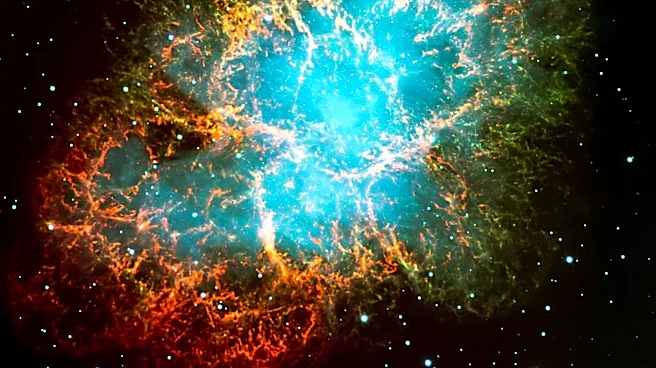
Astronomers have confirmed the first evidence of a binary star system where both stars exploded as supernovae, with their remnants found in the Jellyfish Nebula, also known as IC 443. This discovery, published
in Nature Communications, resolves a long-standing gap in stellar evolution theory. The research, led by a Stanford team, utilized 16 years of gamma-ray data from NASA's Fermi space telescope, along with X-ray, infrared, ultraviolet, and radio observations. The findings show that the remnants, IC 443 and G189.6+3.3, were originally gravitational companions. This confirmation was achieved through multiwavelength evidence and simulations of one million binary systems, with a statistical test showing the odds of a chance alignment are less than one in 1,000.
Why It's Important?
This discovery is significant as it provides the first observational anchor for theoretical models of massive binary stellar evolution. It also offers insights into the conditions of the early universe, where massive stars were more common. The findings could help refine models of how stellar clusters and galaxies evolve, as supernova energy is a primary driver of galactic feedback. Additionally, the discovery raises questions about the origins of the Milky Way's highest-energy cosmic rays, suggesting that sequential supernova shock waves might be more efficient at driving particles to extreme energies.
What's Next?
The Stanford team plans to survey the Milky Way for other binary supernova remnant candidates using the detection framework developed in this study. This could lead to more discoveries of binary systems and help refine predictions about their evolution and impact on cosmic ray production. The Jellyfish Nebula's new distinction as a confirmed binary supernova remnant offers a natural laboratory for testing hypotheses about cosmic ray origins.
Beyond the Headlines
The discovery highlights the importance of multiwavelength observations in astrophysics, as gamma-ray data was crucial in confirming the binary nature of the supernovae. It also underscores the potential for binary supernova systems to replicate early universe conditions, providing a window into the past. The study's findings could influence future research on galactic evolution and the role of supernovae in shaping the cosmos.