



What's Happening?
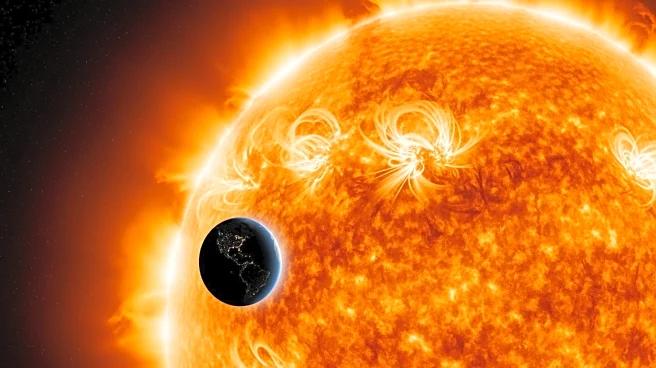
On January 3, 2026, Earth reached its closest point to the sun in its annual orbit, an event known as perihelion. During this time, the sun appears slightly larger in the sky compared to other times of the year. Earth orbits the sun at an average distance
of 93 million miles, but this distance varies slightly due to the elliptical shape of the orbit. At perihelion, Earth is approximately 91.5 million miles from the sun. Despite this proximity, the difference in distance does not significantly affect Earth's temperature or seasons, which are primarily influenced by the tilt of Earth's axis. The sun's angular size at perihelion is marginally larger than at aphelion, the point when Earth is farthest from the sun.
Why It's Important?
The occurrence of perihelion is a reminder of the dynamic nature of Earth's orbit and its impact on astronomical observations. While the event does not affect global temperatures or seasonal changes, it provides an opportunity for astronomers and enthusiasts to observe the sun's slightly larger appearance. Understanding Earth's orbit and its variations is crucial for accurate astronomical calculations and for enhancing public awareness of celestial phenomena. This knowledge also underscores the importance of safe solar observation practices, as looking directly at the sun without proper equipment can cause permanent eye damage.