





What's Happening?
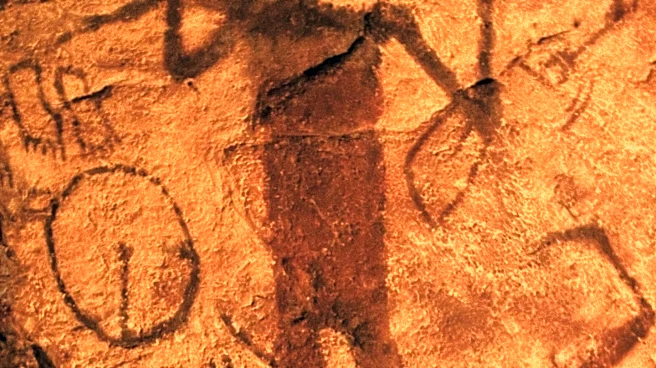
In anthropology, the term 'shamanism' is frequently used to describe traditions where ritual specialists enter altered states of consciousness or interact with spiritual forces for healing or other ceremonies. This concept is particularly relevant in the study
of San rock art, such as that found in Kamberg, KwaZulu-Natal Drakensberg. Researchers interpret certain images in these ancient artworks as depictions of ritual specialists engaged in healing ceremonies or spiritual experiences. These interpretations are based on visual features like unusual postures, bent bodies, outstretched arms, or figures that appear partly human and partly animal, which are seen as possible expressions of ritual transformation or altered states of consciousness. However, the use of the term 'shaman scenes' is an analytical label by researchers and may not reflect the terminology used by the original artists. Careful observation, comparison with other images, and relevant ethnographic information are crucial for accurate interpretation, acknowledging that a single belief from one San community cannot be universally applied across all Drakensberg paintings.
Why It's Important?
The careful application of anthropological terms like 'shamanism' in interpreting ancient art is vital for understanding cultural heritage without imposing modern or external frameworks. Misinterpretations can lead to an inaccurate understanding of historical spiritual practices and the societies that created them. By distinguishing between direct observations and culturally comparative explanations, researchers can maintain academic rigor and respect the nuances of indigenous traditions. This approach helps to preserve the integrity of the San rock art as a record of their unique artistic and spiritual traditions, rather than a generalized representation of 'shamanism.' The ongoing research at sites like Kamberg contributes to a broader understanding of human spiritual expression and the diverse ways societies have engaged with the unseen world, influencing how cultural artifacts are studied and presented globally.
What's Next?
Future research will likely continue to refine the interpretive methodologies for ancient rock art, emphasizing the importance of ethnographic evidence while acknowledging its limitations. Scholars will strive to balance the use of analytical terms with a deep respect for the specific cultural contexts of the art's creators. Conservation efforts at sites like Kamberg will remain critical, focusing on protecting these fragile cultural records from damage and ensuring that interpretive materials acknowledge the living heritage of San communities. This ongoing work will involve interdisciplinary approaches, combining archaeology, anthropology, and indigenous knowledge to foster a more comprehensive and respectful understanding of these invaluable historical records. The aim is to ensure that interpretations are well-supported by multiple features of the composition and relevant cultural evidence, moving beyond simplistic or generalized labels.
Beyond the Headlines
The discussion surrounding 'shamanism' in rock art extends beyond mere academic interpretation; it touches upon ethical considerations of cultural appropriation and the representation of indigenous beliefs. The term itself, derived from the Siberian Tungus Tribe, has become a broad analytical category, sometimes obscuring the specific and diverse spiritual practices of various cultures. This highlights a broader challenge in anthropology: how to categorize and discuss spiritual traditions without homogenizing them or imposing external definitions. The emphasis on careful analysis and the acknowledgment of the living heritage of indigenous communities underscore a shift towards more respectful and collaborative research practices. This approach encourages a deeper appreciation for the complexity of human spirituality and the importance of preserving cultural distinctiveness in the face of globalized interpretations.