
What's Happening?
A team of Chinese researchers has identified eight caves in the Hebrus Valles region of Mars, which may have been sculpted by water. These formations, known as karst caves, are the first of their kind
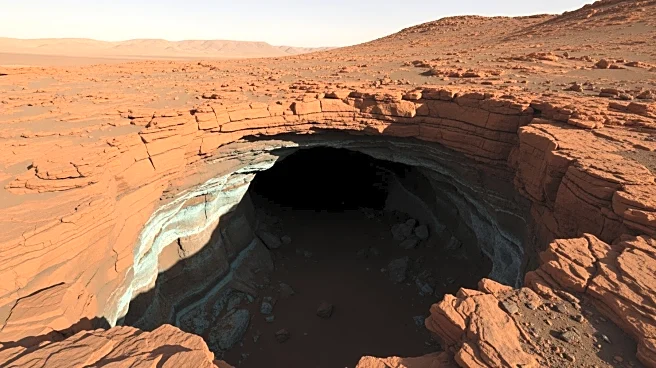
discovered on another planet. Unlike previously known Martian caves formed by volcanic activity, these new formations appear to result from the chemical dissolution of soluble rocks. The discovery, published in The Astrophysical Journal Letters, adds a new category to Mars’ geological record and opens fresh possibilities in the ongoing search for life beyond Earth. The caves, carved long ago, could have preserved biosignatures, making them critical for upcoming exploration missions. The study utilized data from NASA’s orbiters, including the Mars Global Surveyor, to identify these features, which differ from previously documented lava tubes.
Why It's Important?
The discovery of these water-carved caves on Mars is significant as it provides a new avenue for astrobiologists to explore the possibility of life beyond Earth. The caves could have provided a stable and protected microenvironment, potentially preserving signs of life that might otherwise have degraded on the surface. This finding gives researchers a concrete target for future missions, allowing them to focus efforts on specific areas where life-supporting conditions may have existed. The presence of carbonates and sulfates in the surrounding rock suggests that subsurface water flow played a role in shaping these formations, offering insights into Mars' geological history and the potential for past life.
What's Next?
The strategic importance of Martian caves for exploration has been recognized, with proposals to send autonomous miniature rovers into these cave systems. These rovers would use sensor-equipped 'breadcrumbs' to maintain orientation and collect data deep within the structures. High-resolution 3D models of the Hebrus Valles caves, created using data from the Mars Reconnaissance Orbiter, confirm that the shapes of the pits match what would be expected from erosion-induced collapse. This information may help engineers design equipment optimized for subterranean movement and analysis, paving the way for future exploration missions focused on these promising sites.