





What's Happening?
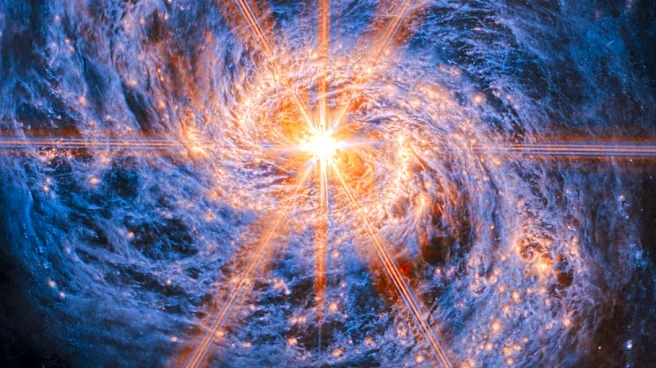
NASA's Chandra X-ray Observatory and the James Webb Space Telescope have identified a new class of astronomical objects known as 'little red dots.' These objects, which emit X-rays, are believed to be a previously unknown stage in the evolution of supermassive
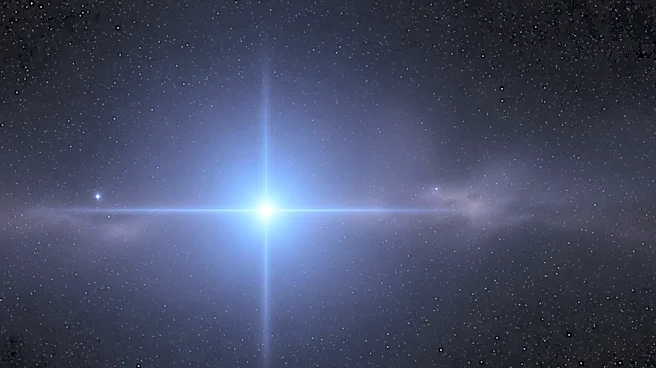
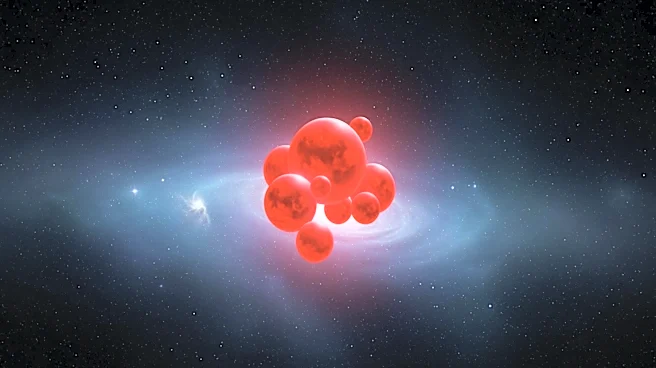
black holes. The discovery was made by comparing older images from Chandra with newer ones from the James Webb Space Telescope. The 'little red dots' are massive and luminous objects that existed in the early universe, approximately 12 billion light years away. They are too massive to be stars and too compact to be galaxies. The recent identification of X-ray emissions from one of these dots supports the theory that they may be 'black hole stars,' where a supermassive black hole is enveloped in a dense cloud of gas, obscuring its emissions.
Why It's Important?
This discovery is significant as it provides new insights into the growth and evolution of supermassive black holes, which are critical to understanding the formation of galaxies and the universe's early history. The identification of 'little red dots' as potential black hole stars could reshape current astronomical models and theories about the universe's infancy. It also highlights the capabilities of modern telescopes like the James Webb Space Telescope in uncovering previously hidden cosmic phenomena. This could lead to further research and discoveries about the universe's structure and the role of black holes in cosmic evolution.
What's Next?
Future research will likely focus on confirming the nature of these 'little red dots' and understanding their role in the universe's evolution. Astronomers may conduct more detailed observations using advanced telescopes to gather additional data. This could involve international collaborations to study these objects from different perspectives and wavelengths. The findings could prompt revisions in theoretical models of black hole formation and growth, influencing future astronomical research and exploration.