
What's Happening?
Astronomers have confirmed the existence of black hole stars in the early universe, a discovery that could solve one of the mysteries observed by the James Webb Space Telescope (JWST). These objects, identified
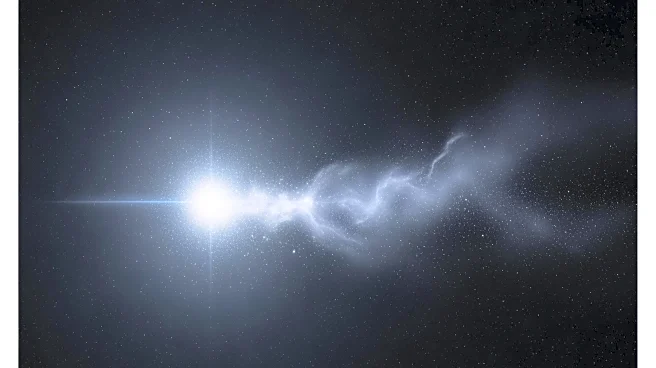
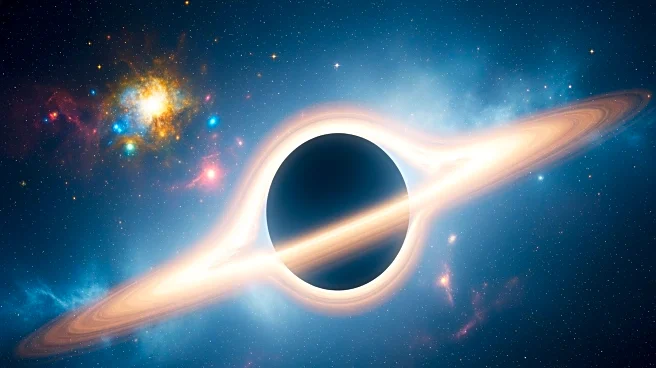
as 'little red dots' (LRDs), are dense spheres of gas with a black hole at their center, emitting light similar to stars. This finding challenges previous theories that LRDs were either supermassive black holes surrounded by dust or densely packed galaxies. The research, led by Anna de Graaff at Harvard University, analyzed over a hundred galaxies and concluded that the LRDs are best explained by the black hole star model. This model suggests that the gravitational energy released as material falls into the black hole causes the surrounding gas to glow, creating a star-like appearance.
Why It's Important?
The confirmation of black hole stars provides a new understanding of the early universe's structure and the formation of supermassive black holes. This discovery could lead to the development of new models explaining the growth and evolution of these massive cosmic entities. Understanding black hole stars may also offer insights into the conditions of the early universe, potentially revealing how these objects influenced the formation of galaxies and other cosmic structures. The findings challenge existing astrophysical theories and open new avenues for research into the universe's formative years.
What's Next?
Further research is needed to understand the formation and evolution of black hole stars. Astronomers will likely focus on observing these objects over time to study their variability and confirm the presence of black holes at their centers. This could involve using gravitational lensing techniques to observe changes in brightness and gather more data on their structure and behavior. The development of new theoretical models will be crucial in explaining how these stars form and their role in the universe's evolution. As more data becomes available, the scientific community will continue to refine its understanding of these enigmatic objects.