
What's Happening?
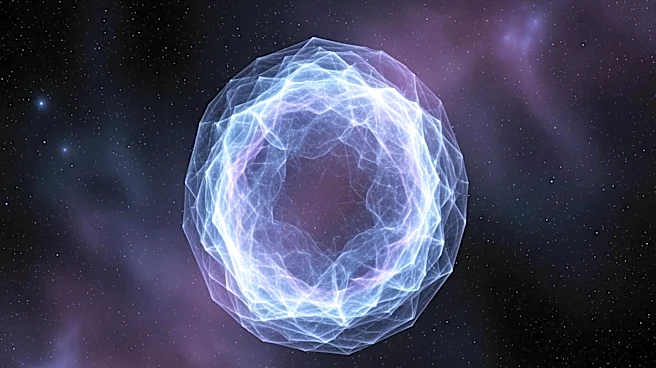
The Gemini North telescope in Hawaii has captured a breathtaking image of the Crystal Ball Nebula, also known as NGC 1514. This planetary nebula, located approximately 1,500 light-years away in the constellation
Taurus, consists of two stars orbiting each other every nine years. According to the U.S. National Science Foundation's NOIRLab, one of these stars, once several times more massive than the sun, has begun releasing its outer layers as it dies. The interaction between the progenitor star and its binary companion shapes the expanding shell of gas, creating the nebula's distinctive lumpy layers. This image not only showcases the beauty of cosmic objects but also serves as a window into the past, as the light from the nebula took 1,500 years to reach Earth.
Why It's Important?
The image of the Crystal Ball Nebula is significant as it provides insight into the life cycle of stars and the formation of planetary nebulas. By studying such cosmic phenomena, scientists can better understand the processes that govern the universe. The ability to observe these distant objects also highlights the advancements in astronomical technology, allowing researchers to look back in time and study the history of the cosmos. This contributes to the broader field of astrophysics and enhances our understanding of the universe's evolution.