





What's Happening?
The University of Illinois Urbana-Champaign has dedicated a new time capsule at Huff Hall, commemorating its 100th anniversary. This event follows the discovery and opening of an original time capsule from 1924, which contained well-preserved artifacts
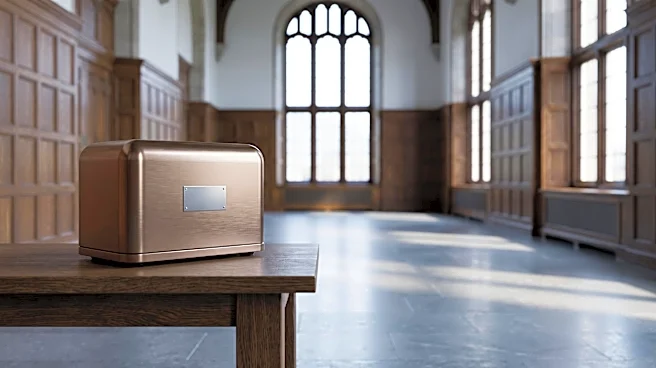
including photos of University President David Kinley and Illinois football legend Harold “Red” Grange. The new capsule, a metal box about the size of a toaster oven, will be placed in the cornerstone of Huff Hall and is scheduled to be opened in 2126. It contains items specific to both the Applied Health Sciences and the Division of Intercollegiate Athletics, reflecting the intertwined history of these two facets of Huff Hall. Among the contents are a brick from the Khan Annex dedication, technology created by AHS such as the i-Phagia Sensor, and a book by athletics historian Kent Brown. Letters from Dean of Applied Health Sciences Cheryl Hanley-Maxwell, Director of Athletics Josh Whitman, Chancellor Charles Isbell Lee Jr., and university alum Shahid Khan, namesake of the Khan Annex, are also included.
Why It's Important?
This initiative is important for preserving the historical legacy of the University of Illinois and Huff Hall, ensuring that future generations can connect with the institution's past. The inclusion of letters from key figures like Dean Hanley-Maxwell and Director Whitman provides a unique snapshot of the university's aspirations and values in the present day, offering insights into the academic and athletic landscape of the early 21st century. The time capsule also highlights the significant contributions of alumni like Shahid Khan, whose philanthropy has shaped the university's infrastructure, as evidenced by the Khan Annex. By documenting the evolution of both academic and athletic programs, the capsule serves as a valuable educational tool, fostering a sense of continuity and tradition within the university community. The careful preservation methods, such as filling the capsule with argon gas, underscore the commitment to ensuring the longevity and integrity of these historical records.
What's Next?
The new time capsule will remain sealed in the cornerstone of Huff Hall until 2126, at which point it will be opened, providing a glimpse into the past for future university members. The inclusion of the capsule in a national registry for time capsules ensures its record will not be lost, guaranteeing its eventual discovery and opening. The university will continue to celebrate its history and the contributions of its community members through such commemorative events. The items from the original 1924 capsule that were not placed in the new one will be transferred to the University Archives, making them accessible for historical research and public viewing. This ongoing commitment to historical preservation will likely inspire similar initiatives at other institutions, reinforcing the importance of documenting institutional memory for future generations.
Beyond the Headlines
The act of creating and preserving a time capsule transcends mere historical record-keeping; it is a profound statement about hope, legacy, and the human desire to communicate across generations. It encourages reflection on the values and challenges of the present, as individuals like Dean Hanley-Maxwell articulate their hopes for a more inclusive and accessible future. The contrast between the discovery of the 1924 capsule and the meticulous planning for the new one also highlights advancements in preservation science and the growing awareness of the importance of safeguarding cultural heritage. This project subtly reinforces the idea that institutions like universities are not just places of learning but living entities with a continuous narrative, shaped by the past and influencing the future. It also serves as a reminder of the enduring impact of individual contributions, such as Shahid Khan's, on the physical and intellectual landscape of educational institutions.