
What's Happening?
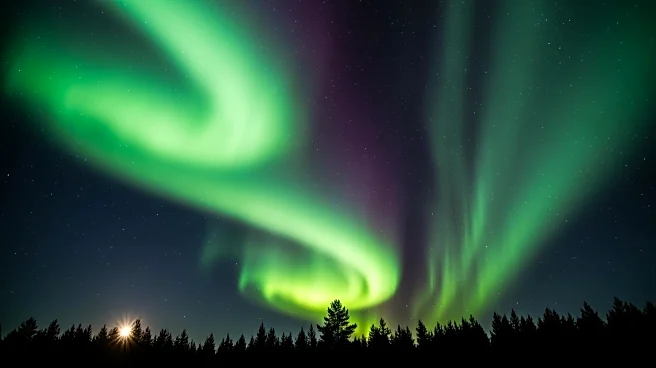
A powerful solar storm, triggered by a coronal mass ejection (CME) from the Sun, resulted in a spectacular display of auroras, commonly known as the Northern Lights, on January 19. This event was caused
by a CME that erupted from the Sun's corona during a significant X1.9 solar flare. The CME traveled the approximately 91 million miles from the Sun to Earth in about one day, causing geomagnetic storms that fluctuated between G1 and G4 levels. These storms led to the auroras being visible in mid-latitude regions, far beyond their usual polar confines. The colorful display, featuring hues of red, green, and magenta, was observed in various locations, including Germany and the southwestern United States. The auroras lasted several hours due to the continued interaction of the CME with Earth's magnetic field, resulting in repeated surges of auroral activity.
Why It's Important?
The occurrence of such a powerful solar storm highlights the potential impact of space weather on Earth. Geomagnetic storms can disrupt satellite operations, GPS systems, and power grids, posing risks to technological infrastructure. The widespread visibility of the auroras in mid-latitude regions underscores the intensity of the CME and its effects on Earth's magnetosphere. This event serves as a reminder of the need for continued monitoring and preparedness for space weather phenomena, which can have significant implications for communication systems and other critical technologies. The ability to predict and mitigate the effects of such events is crucial for minimizing potential disruptions.
What's Next?
Future monitoring of solar activity will be essential to anticipate and respond to similar events. Scientists and space weather agencies will continue to study the effects of CMEs and geomagnetic storms to improve predictive models and develop strategies to protect technological infrastructure. Increased awareness and preparedness can help mitigate the impact of future solar storms on communication systems, power grids, and other critical technologies. Collaboration between international space agencies and research institutions will be vital in advancing our understanding of space weather and its potential effects on Earth.