



What's Happening?
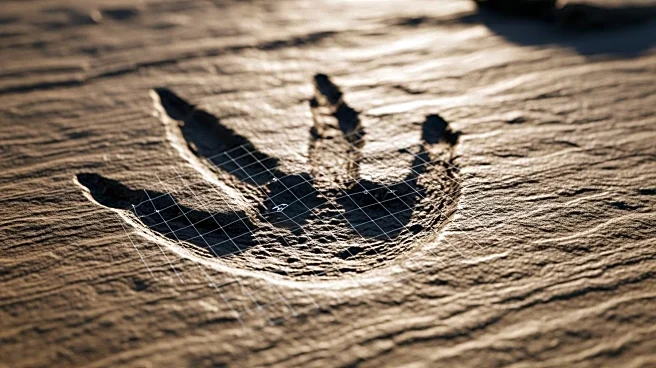
A new artificial intelligence tool, DinoTracker, has been developed to analyze dinosaur footprints, offering a fresh perspective on the origin and evolution of birds. This tool, created by researchers at a Helmholtz Research Center in Berlin and the University
of Edinburgh, uses AI to interpret the complex and often ambiguous nature of dinosaur tracks. By training on nearly 2,000 real fossil footprints and millions of simulated variations, the AI can identify key traits in footprints, such as toe spread and heel position, to determine the likely dinosaur species. The tool has achieved around 90% agreement with human expert classifications, even in controversial cases. Notably, the AI identified bird-like features in footprints over 200 million years old, suggesting either an earlier origin for birds or that some early dinosaurs had bird-like feet.
Why It's Important?
The development of DinoTracker represents a significant advancement in paleontology, providing a more objective and data-driven method for classifying dinosaur footprints. This tool could transform how scientists study dinosaur movement and evolution, potentially revising timelines for the emergence of major groups like birds. By offering a consistent second opinion, the AI can highlight tracks that warrant further study, thus refining our understanding of prehistoric life. Additionally, DinoTracker's accessibility could democratize paleontological research, allowing both scientists and the public to engage with dinosaur evidence more interactively. This could lead to new discoveries and insights into how these ancient creatures lived and evolved.
What's Next?
DinoTracker is poised to be used in various settings, from research to education and fieldwork. In research, it can quickly screen large numbers of tracks and identify patterns across different sites. In educational contexts, it can make learning about dinosaur footprints more interactive. For fieldwork, it offers a rapid way to test hypotheses, especially in remote locations where expert interpretation is not readily available. As the tool gains wider use, it may lead to new discoveries about dinosaur behavior and evolution, potentially reshaping our understanding of the prehistoric world.
Beyond the Headlines
The implications of DinoTracker extend beyond immediate scientific findings. By treating variation in footprints as valuable information rather than noise, the tool encourages a more nuanced understanding of dinosaur tracks. This approach could influence other areas of paleontological research, promoting methods that embrace complexity and variability. Furthermore, the tool's ability to make ancient worlds more accessible and understandable could inspire greater public interest in paleontology, fostering a deeper appreciation for the history of life on Earth.