



What's Happening?
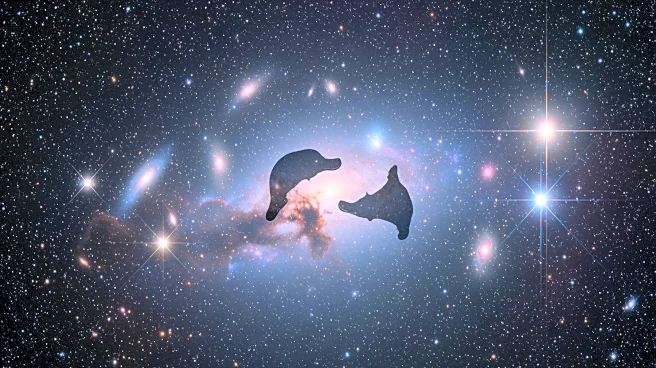
The James Webb Space Telescope has identified a new category of cosmic objects, termed 'platypus galaxies,' which are defying current astronomical classification systems. These nine galaxies, discovered in archival data, are small and compact but do not
exhibit characteristics typical of active supermassive black holes or quasars. The term 'platypus galaxies' is inspired by the platypus animal, known for its unique and hard-to-classify features. The research, led by astronomer Haojing Yan from the University of Missouri, was presented at the American Astronomical Society meeting. The galaxies' spectra are narrow and sharp, indicating slower gas movement, unlike typical quasars. This discovery suggests these galaxies might represent a new type of star-forming galaxy from the early universe, although their compact size remains puzzling.
Why It's Important?
This discovery is significant as it challenges existing theories of galaxy formation and evolution. The identification of 'platypus galaxies' could provide new insights into the early universe's structure and the processes that led to the formation of galaxies. Understanding these galaxies could reshape scientific perspectives on how galaxies evolve and the role of supermassive black holes in this process. The findings could also influence future astronomical research and the development of new models to explain galaxy formation. This has implications for the broader field of astrophysics, potentially leading to a reevaluation of how cosmic structures are classified and understood.
What's Next?
Further research is needed to understand the nature of these 'platypus galaxies.' The team plans to gather more galactic samples to continue their study. The James Webb Space Telescope, still early in its operational life, will play a crucial role in this ongoing research. As the telescope continues to observe the universe, it may uncover more such galaxies, providing additional data to refine or challenge current theories. The scientific community will likely focus on these findings to explore the potential existence of other unknown galaxy types and their implications for our understanding of the universe.