





What's Happening?
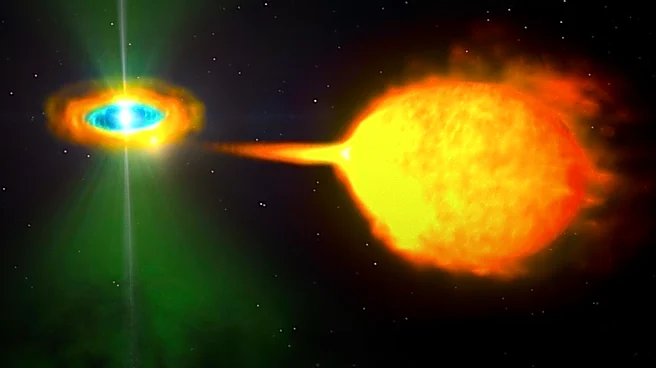
Astronomers using NASA's Hubble Space Telescope have observed a unique stellar explosion in the Milky Way, known as V445 Puppis, which is ejecting cosmic 'bullets' at speeds of 20 million miles per hour. This event, identified as the only known 'helium
nova' in our galaxy, was initially obscured by a cloud of debris. Once the debris cleared, researchers discovered that V445 Puppis consists of a white dwarf star feeding on a companion helium star. This rare binary system offers scientists a unique opportunity to study one of the rarest types of cosmic explosions.
Why It's Important?
The discovery of V445 Puppis and its unique characteristics provides valuable insights into the nature of helium novas and their potential to evolve into Type Ia supernovas. These supernovas are critical for understanding cosmic distances and the expansion rate of the universe, as they serve as 'standard candles' in astronomical measurements. The findings could also enhance our understanding of stellar evolution and the dynamics of binary star systems. This research underscores the importance of continued observation and study of such rare cosmic events.
What's Next?
Researchers anticipate that V445 Puppis may experience another nova explosion, which could lead to a Type Ia supernova. Such an event would provide further opportunities to study the mechanisms behind these powerful cosmic explosions. Future observations using advanced telescopes and instruments could help confirm the nature of the 'bullets' and the processes driving this unique nova. The scientific community will likely focus on monitoring V445 Puppis and similar systems to gain deeper insights into stellar phenomena and their implications for our understanding of the universe.