



What's Happening?
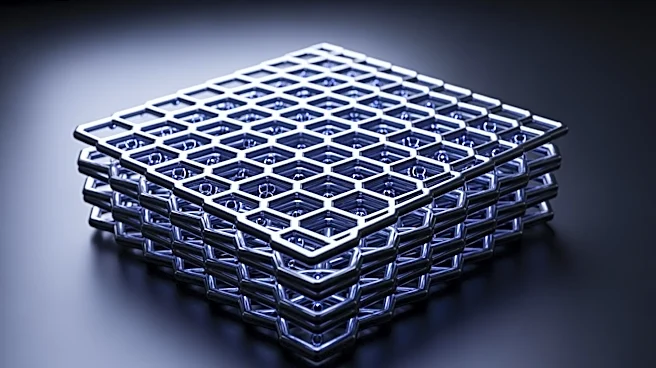
Researchers have developed a new method to produce MXenes, a family of ultra-thin inorganic materials, with perfect atomic order, significantly boosting their conductivity. The GLS method uses molten salts and iodine vapor to form MXene sheets, allowing
precise control over surface atoms. This cleaner synthesis results in a 160-fold increase in macroscopic conductivity and a 13-fold enhancement in terahertz conductivity for titanium carbide MXene Ti3C2. The ordered structure reduces electron trapping and scattering, offering improved stability and tailored functional properties.
Why It's Important?
The breakthrough in MXene production has significant implications for electronics and advanced technologies. The enhanced conductivity and electron mobility could lead to more efficient electronic devices, including flexible electronics and high-speed communication systems. The ability to customize MXenes for specific uses, such as electromagnetic shielding and radar-absorbing coatings, opens new possibilities for technological innovation. This advancement could accelerate the development of next-generation technologies, contributing to economic growth and technological competitiveness.
What's Next?
The GLS method allows for further customization of MXenes by combining different halide salts, enabling the creation of materials with specific electromagnetic properties. Researchers aim to explore the potential applications of these materials in electronics, catalysis, energy storage, and photonics. The continued development of MXenes with tailored properties could lead to breakthroughs in various industries, enhancing the performance and efficiency of technological solutions.
Beyond the Headlines
The study highlights the importance of surface atom arrangement in determining material properties. The ability to control surface composition provides a powerful tool for designing materials with specific functionalities. This approach could lead to new applications in fields such as optoelectronics and energy storage, driving innovation and expanding the possibilities for material science.