





What's Happening?
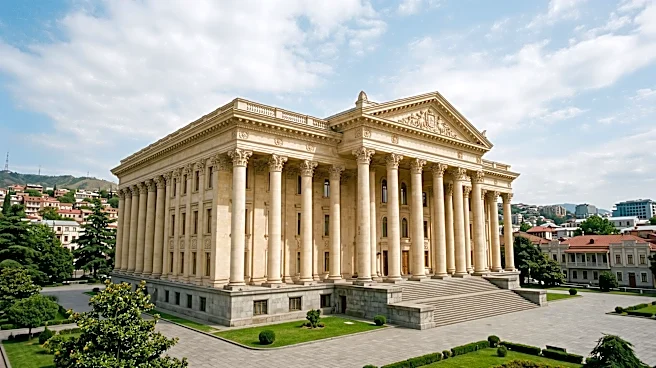
Chinese Vice President Han Zheng recently concluded a three-day official visit to Tbilisi, Georgia, meeting with President Mikheil Kavelashvili and Prime Minister Irakli Kobakhidze. The visit underscores Beijing's growing strategic interest in the South
Caucasus region and Georgia's ambition to become a logistics hub along the Middle Corridor. Discussions during the visit covered the strategic partnership, a free trade agreement, increased Chinese investment, transport infrastructure, and a potential sixth Silk Road Forum in Tbilisi. President Kavelashvili thanked China for its support of Georgia's sovereignty and territorial integrity, while reaffirming Georgia's 'One China' position. This visit occurs amidst deteriorated relations between Georgia and the European Union, with Tbilisi having suspended EU accession talks until 2028 and facing potential sanctions from the European Parliament.
Why It's Important?
This visit is significant for the U.S. as it highlights China's expanding geopolitical influence into regions traditionally considered within Europe's sphere of interest. Georgia's pursuit of Chinese investment for its logistics role in the Middle Corridor, a route bypassing Russia, could create new economic dependencies and alter regional power dynamics. For the U.S., this could mean increased competition with China for influence in strategic corridors and potential challenges to its efforts to promote democratic governance and Western integration in the region. The visit also provides Georgia with a diplomatic counterweight to its strained relations with the European Union, potentially complicating Western efforts to encourage reforms in Tbilisi. The U.S. Helsinki Commission has already voiced concerns about Chinese control and dominance in the Black Sea region, indicating that deeper Chinese engagement in Georgia could raise scrutiny from Washington.
What's Next?
The visit is currently viewed as a strategic signaling exercise, with the outcome dependent on whether Chinese involvement in Georgia's strategic infrastructure becomes consistent. Potential scenarios include continued growth in trade, tourism, and connectivity at current rates with limited Chinese investment, or an incremental increase in Beijing's involvement through financing and transport projects without controlling stakes. A third scenario, involving significant Chinese capital in Black Sea ports or other strategic infrastructure, would likely intensify Western scrutiny and could harden responses from the EU and the U.S. Key indicators to monitor include rising Chinese investment in strategic infrastructure, Beijing's reconsideration of the Anaklia port project, future official Georgian visits to Beijing, and any Georgian fiscal laws offering incentives to Chinese investors.
Beyond the Headlines
Beyond the immediate economic and political implications, Han Zheng's visit to Georgia touches upon deeper themes of geopolitical competition and the evolving global order. Georgia's strategic location at the crossroads of Europe and Asia makes it a critical node in the broader Belt and Road Initiative. China's support for Georgia's territorial integrity, while receiving a reaffirmation of the 'One China' policy, highlights a transactional approach to diplomacy that prioritizes economic and strategic alignment over adherence to Western democratic norms. This could set a precedent for other nations seeking alternative partnerships amidst strained relations with traditional allies. The potential for increased Chinese presence in the Black Sea region also raises questions about long-term security implications, particularly in the context of the ongoing conflict in Ukraine and Russia's own logistics projects. The visit underscores the complex interplay of economic necessity, geopolitical ambition, and regional security in shaping international relations.