



What's Happening?
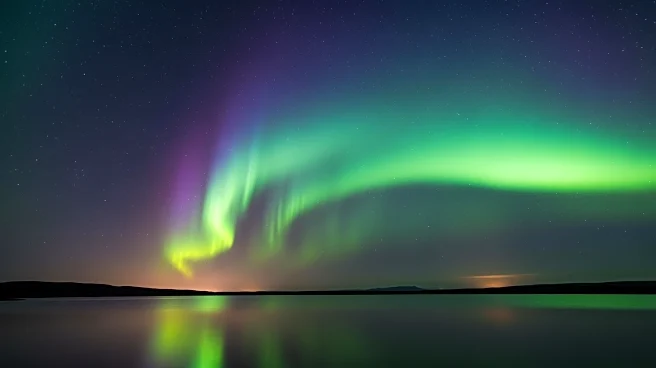
A significant solar storm, the most powerful in over two decades, occurred on Tuesday night, resulting in spectacular auroral displays, commonly known as the Northern Lights, visible far beyond their typical polar confines. According to Space.com, the event
was triggered by an intense X-class solar flare, the strongest recorded in 23 years, which propelled a fast coronal mass ejection (CME) towards Earth. This CME impacted Earth's magnetic field at approximately 2:38 pm EST on January 19, elevating geomagnetic conditions to G4, or 'severe' storm levels, as reported by the US National Oceanic and Atmospheric Administration’s (NOAA) Space Weather Prediction Centre (SWPC). The CME was launched on January 18 during a powerful X1.9 solar flare, allowing it minimal time to traverse the approximately 91 million miles between the Sun and Earth.
Why It's Important?
The occurrence of such a powerful solar storm has significant implications for both scientific research and practical applications. The increased geomagnetic activity can disrupt satellite operations, GPS systems, and power grids, posing challenges for industries reliant on these technologies. Additionally, the event provides a unique opportunity for scientists to study the effects of solar activity on Earth's magnetic field and atmosphere. The visibility of the Northern Lights in regions where they are not typically seen also highlights the potential for increased public interest and awareness of space weather phenomena. This heightened awareness could lead to more robust preparedness measures and technological innovations to mitigate the impacts of future solar storms.
What's Next?
In the aftermath of this solar storm, scientists and space weather agencies will likely continue to monitor the Sun's activity closely to predict and prepare for future events. The data collected from this storm will be analyzed to improve forecasting models and enhance our understanding of solar-terrestrial interactions. Stakeholders in the telecommunications and energy sectors may also review and update their contingency plans to ensure resilience against similar occurrences. Public interest in space weather may drive educational initiatives and increased funding for research in this field.