


What's Happening?
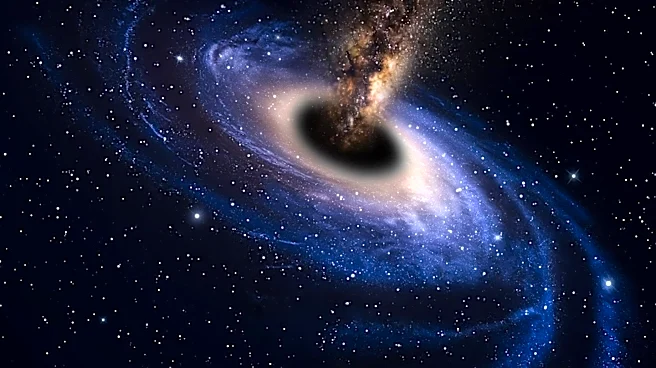
A recent study by scientists at Eötvös Loránd University and their collaborators suggests that supermassive black holes, typically found at the centers of galaxies, can be dislodged from their original positions after galactic mergers. The research, published
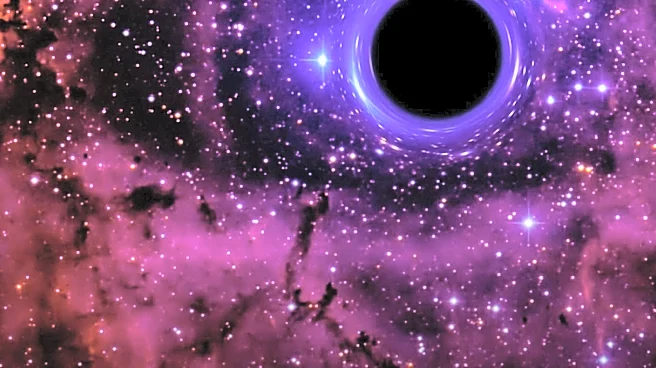
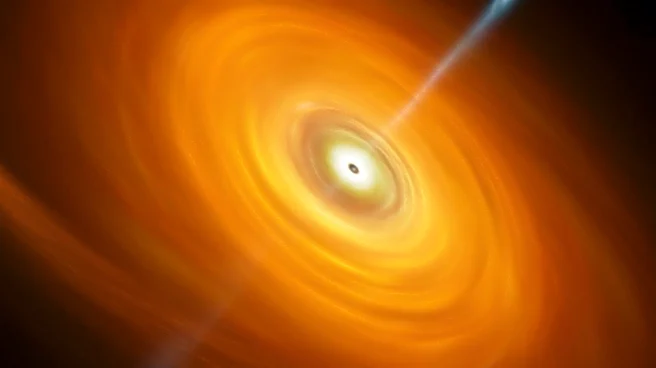
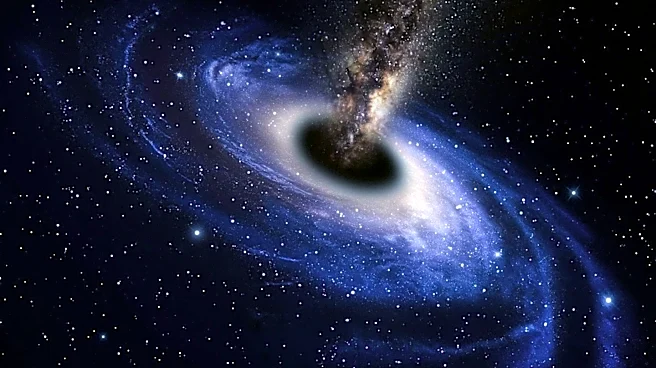
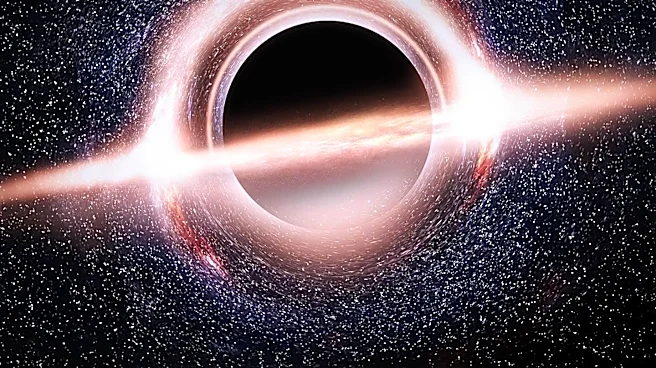
in Monthly Notices of the Royal Astronomical Society, examined approximately 100,000 bright galactic cores, known as quasars. When galaxies collide, their central black holes can merge, releasing gravitational waves. An uneven emission of these waves can impart a 'kick' to the newly formed black hole, pushing it in a specific direction. If this kick is not powerful enough for the black hole to escape the galaxy entirely, it may oscillate around its original location. The study found a statistical pattern, predicted a decade ago, indicating that faster-moving central black holes are generally associated with more dust-obscured light, a relationship observed in data from the Sloan Digital Sky Survey. This pattern suggests that some quasars contain black holes that have been disturbed by previous mergers.
Why It's Important?
This finding offers new evidence for a significant consequence of gravitational waves and their impact on galactic evolution. Understanding how black hole mergers reshape galactic centers is crucial for comprehending the dynamics and development of galaxies. The displacement of supermassive black holes could influence the distribution of matter and star formation within galaxies. Furthermore, the study highlights the value of large astronomical surveys, demonstrating how patterns that are difficult to discern in individual galaxies can emerge when comparing vast numbers of objects. This approach could lead to a more comprehensive understanding of cosmic phenomena that are otherwise challenging to observe. The research also provides insights into how gravitational waves, a fundamental prediction of Einstein's theory of relativity, can influence the movement of enormous celestial objects, thereby advancing our knowledge of fundamental physics.
What's Next?
The researchers emphasize that while the findings provide strong evidence, they do not definitively prove that any single black hole was displaced. Further observations and modeling are needed to confirm these results. Scientists will likely conduct additional studies to verify the statistical patterns and explore other potential processes that could produce similar effects. Determining the proportion of recently merged systems with displaced black holes remains an area for future investigation. If confirmed, this research could lead to new methods for identifying galaxies that have undergone recent mergers and for studying the aftermath of these colossal cosmic events. Continued analysis of large astronomical datasets will be essential to refine our understanding of black hole dynamics and their role in shaping the universe.
Beyond the Headlines
The concept of black holes being 'kicked' from galactic centers introduces a dynamic element to our understanding of galactic evolution. This phenomenon could have long-term implications for the distribution of supermassive black holes throughout the universe and their interactions with surrounding matter. It also underscores the profound influence of gravitational waves, not just as ripples in spacetime, but as forces capable of moving objects of immense mass. The study's reliance on large-scale data analysis exemplifies a growing trend in astrophysics, where the sheer volume of observational data allows for the discovery of subtle, yet significant, patterns that would be impossible to detect through individual observations. This shift towards 'big data' astronomy is transforming our ability to unravel the universe's most complex mysteries.