




What's Happening?
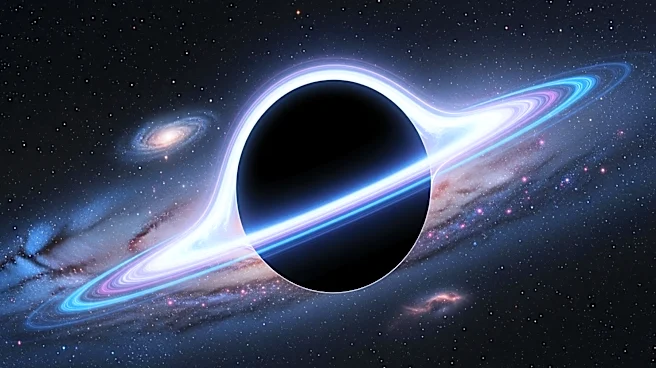
Astronomers have identified a supermassive black hole, ULAS J1120+0641, that appears to have outgrown its host galaxy, presenting a significant imbalance that challenges current understanding of galaxy formation. Observations from the James Webb Space
Telescope (JWST) revealed a crowded field of early galaxies surrounding the black hole, yet the host galaxy remains disproportionately small. This discovery suggests that some black holes in the early universe may have grown rapidly, outpacing their galaxies. The study, led by Meredith Stone from the University of Arizona, found that even potential future mergers with nearby galaxies would not suffice to balance the system. The black hole, a quasar seen as it existed 12.9 billion years ago, forces astronomers to reconsider how such imbalances could have formed so early in the universe's history.
Why It's Important?
The discovery of ULAS J1120+0641's imbalance is significant as it challenges the conventional model where black holes and their host galaxies grow in tandem. This finding could reshape theories about galaxy and black hole evolution, particularly in the early universe. The implications extend to understanding cosmic growth patterns and the role of black holes in galaxy formation. If such imbalances are more common than previously thought, it could mean that the universe harbors many more 'misfit' systems, potentially altering the perceived distribution and evolution of galaxies. This could impact future astronomical research and the methods used to study cosmic structures.
What's Next?
Future observations are expected to focus on mapping hidden gas and faint companion galaxies to determine whether ULAS J1120+0641 is truly an anomaly or part of a broader pattern. These studies will help clarify whether the system is fading or simply unfinished. The findings could lead to a reevaluation of how astronomers search for and interpret data on distant galaxies and black holes. As technology advances, more detailed observations may reveal additional systems with similar imbalances, providing further insights into the early universe's dynamics.