
What's Happening?
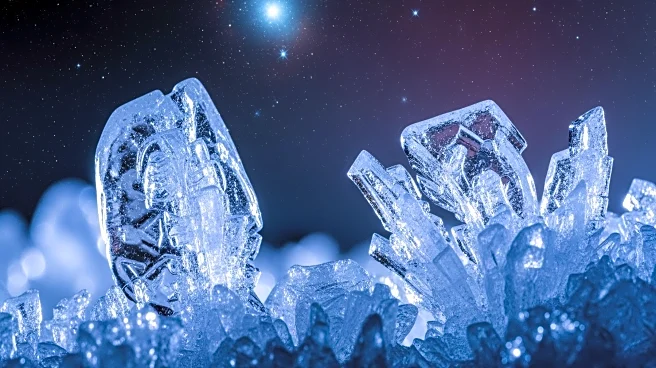
A new study suggests that the building blocks of life, such as peptides, may have formed in the cold interstellar medium, challenging the traditional view that they originated in warm, wet environments
like Earth's oceans. Researchers demonstrated that peptides can form inside icy dust grains exposed to cosmic radiation, which provides the energy needed to link amino acids without liquid water. This discovery broadens the potential environments where life's precursors could form, indicating that complex molecules necessary for life are naturally created in space.
Why It's Important?
This research has significant implications for our understanding of the origins of life. By showing that life's building blocks can form in the harsh conditions of space, it expands the potential for life beyond Earth, suggesting that life could emerge on planets within habitable zones of newly formed solar systems. This finding could influence future astrobiological studies and the search for extraterrestrial life, as it highlights the possibility of life-forming processes occurring in diverse cosmic environments.
What's Next?
The research team plans to explore the formation of other peptides in interstellar space, which could further elucidate the processes that lead to the emergence of life. This ongoing research may provide deeper insights into the chemical pathways that contribute to life's complexity, potentially guiding future space missions and experiments aimed at detecting life beyond Earth.