



What's Happening?
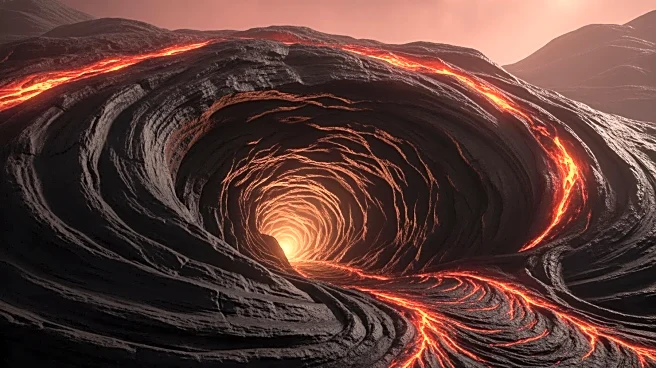
Astronomers have identified a large cave beneath the surface of Venus, providing strong evidence for the existence of lava tubes on the planet. The discovery, made using radar data from NASA's Magellan spacecraft, suggests that Venus's surface is tunneled
with pyroducts formed by volcanic activity. This finding enhances our understanding of Venus's geological history and the processes that shaped its surface.
Why It's Important?
The discovery of lava tubes on Venus offers new insights into the planet's volcanic history and geological evolution. Understanding these structures can inform theories about Venus's formation and the role of volcanism in shaping planetary surfaces. This research may also have implications for future exploration missions, as lava tubes could provide shelter for robotic or human explorers.
What's Next?
Further studies are needed to explore the extent and characteristics of Venus's lava tubes. Researchers may focus on acquiring higher-resolution images and data to map these structures and understand their formation. This ongoing research could lead to new discoveries about Venus and its geological processes.