





What's Happening?
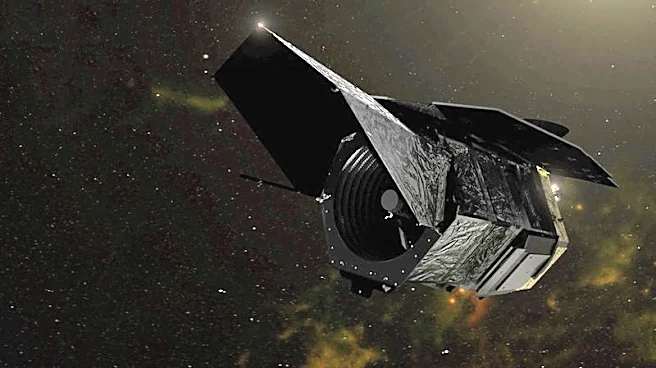
The National Aeronautics and Space Administration (NASA), in collaboration with the Japan Aerospace Exploration Agency (JAXA), has utilized data from the X-ray Imaging and Spectroscopy Mission (XRISM) observatory to directly observe a pulsar capturing
stellar wind from its companion star. This phenomenon, where a giant star's outflow (stellar wind) is captured by a compact object, powers strong X-ray flares. The research, published in the journal Science Advances, focuses on the BP Crucis system, a high-mass X-ray binary located approximately 13,000 light-years away. The system consists of Wray 977, a blue hypergiant 40 times the Sun's mass, and GX 301-2, a neutron star (pulsar) that rotates every 11 minutes. The XRISM's Resolve instrument captured highly detailed X-ray spectra, revealing rapidly changing emission and absorption lines, particularly from highly ionized iron, which indicated the speed and direction of plasma near the pulsar. This marks the first time clear indications of wind plasma falling onto a compact object have been observed, providing unprecedented detail into these processes.
Why It's Important?
This observation is crucial for advancing humanity's understanding of the extreme universe and fundamental astrophysical processes. By directly witnessing a pulsar accreting stellar wind, scientists can test and refine existing models of how compact objects interact with their environments and generate powerful X-ray emissions. The detailed X-ray spectra provided by XRISM's Resolve instrument offer a unique window into the dynamics of plasma flow in such extreme conditions, including the formation and dissipation of accretion disks around neutron stars. This research contributes significantly to NASA's broader exploration efforts aimed at comprehending the cosmos. The insights gained from studying systems like BP Crucis can inform our understanding of other high-energy phenomena in the universe, potentially shedding light on the evolution of stars, galaxies, and the fundamental laws of physics under extreme gravitational and magnetic fields.
What's Next?
Researchers plan to continue analyzing data from the XRISM mission to further refine their understanding of wind-fed pulsar accretion. The BP Crucis system is considered an ideal laboratory for these studies, and the sensitive, high-resolution Resolve spectrometer is expected to yield more insights. Future observations with XRISM and other advanced observatories may target similar systems to confirm these findings and explore variations in the accretion process. The detailed information on plasma velocity and direction obtained from the iron absorption lines will be used to develop more accurate simulations of these binary systems. This ongoing research will contribute to a more comprehensive picture of how matter behaves in the vicinity of neutron stars and black holes, potentially leading to new discoveries about the most energetic events in the universe.
Beyond the Headlines
The ability to directly observe and measure the dynamics of stellar wind accretion onto a pulsar represents a significant leap in observational astrophysics. Beyond the immediate scientific implications, this achievement highlights the power of international collaboration in space exploration, as XRISM is a joint mission between NASA and JAXA. The technological advancements in X-ray spectroscopy, exemplified by the Resolve instrument, are pushing the boundaries of what can be observed and understood in the distant cosmos. This research also underscores the importance of long-term investments in space science and technology, as the data collected from missions like XRISM provide the foundational knowledge necessary for future breakthroughs. The insights gained from studying these extreme environments can also have broader implications for theoretical physics, potentially challenging or confirming our current understanding of gravity and matter under conditions far beyond what can be replicated on Earth.