





What's Happening?
A new book by Colby College sociology professor Neil Gross, titled 'What Happened to College? How Politics Broke Higher Education and What We Can Do to Fix It,' published by Simon & Schuster, posits that students are largely responsible for the increasing
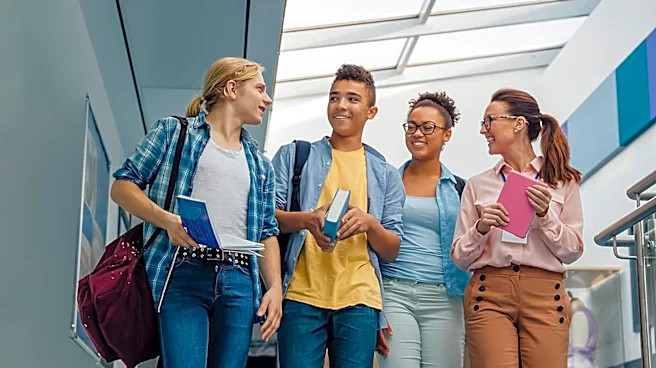
political polarization on U.S. college campuses. Gross's research, which includes nationally representative surveys of four-year undergraduates and interviews with 100 students and recent alumni from 18 institutions, suggests that students actively create 'political bubbles' through their choices of roommates, friends, clubs, majors, and even the universities they attend. While conservatives often accuse universities of liberal indoctrination, Gross argues that colleges are not doing enough to counteract students' ideological self-isolation. He highlights that a significant number of students consider a university's political reputation when applying, leading to a growth of institutions becoming either more progressive or more conservative in their student body leanings. This phenomenon, termed 'affective polarization,' causes individuals with differing beliefs to view the opposing side as immoral or hateful, a sentiment that Gross believes higher education should actively counter.
Why It's Important?
The findings presented in Gross's book are important for understanding the evolving landscape of higher education in the U.S. The argument that student choices, rather than solely institutional influence, are a primary driver of campus polarization shifts the focus of responsibility and potential solutions. This perspective challenges the common narrative that universities are solely to blame for ideological divides, suggesting a more complex interplay between individual student decisions and the broader societal trend of polarization. If students are indeed self-sorting into ideologically homogenous environments, it could hinder critical thinking, limit exposure to diverse viewpoints, and potentially exacerbate societal divisions. For universities, this research underscores the need to re-evaluate strategies for fostering civil discourse and intellectual diversity. The implications extend to the future workforce and civic engagement, as graduates from increasingly polarized environments may be less equipped to navigate complex, diverse professional and social settings, potentially impacting national unity and problem-solving capabilities.
What's Next?
Gross suggests several potential solutions for colleges to address this polarization. One key recommendation is to increase political diversity among both students and faculty. For students, this could involve admissions officers considering ideological spread, not by directly prioritizing ideology, but by leaning into existing efforts like recruiting from rural areas or through religious institutions, which might correlate with different ideological positions. For faculty, he proposes making lines available in areas that tend to attract a greater variety of applicants, such as rural sociology, while still maintaining academic merit as the primary hiring criterion. Long-term, Gross advocates for efforts to encourage more young people with diverse ideological views to pursue careers in higher education. These proposed changes aim to create environments where meaningful debates can occur and 'cancel culture' can be mitigated. The book also implies that if colleges actively work to counter affective polarization, it could have a broader positive impact on communities beyond the campus.
Beyond the Headlines
The book's insights delve into the deeper societal implications of polarization, suggesting that the issue extends beyond campus boundaries and reflects a broader national trend. The concept of 'affective polarization,' where individuals not only disagree but also harbor dislike or hatred for those with opposing views, highlights a fundamental challenge to democratic discourse and social cohesion. By focusing on student choices, the book implicitly raises questions about individual agency and responsibility in perpetuating or mitigating societal divides. The discussion about increasing political diversity in academia also touches upon the ethical considerations of affirmative action and the balance between academic freedom and ideological representation. Furthermore, the observation that parents remain a significant influence on students' political views, even during college, suggests a persistent intergenerational transmission of political attitudes, complicating efforts to foster independent thought and open-mindedness on campuses. This research prompts a re-evaluation of how higher education can fulfill its role in preparing citizens for a diverse and often contentious world.