






What's Happening?
Agricultural organizations across Canada are calling for the establishment of a national plant breeding strategy to ensure predictable funding and advance crop development. Grain Farmers of Ontario, along with several other producer and industry groups,
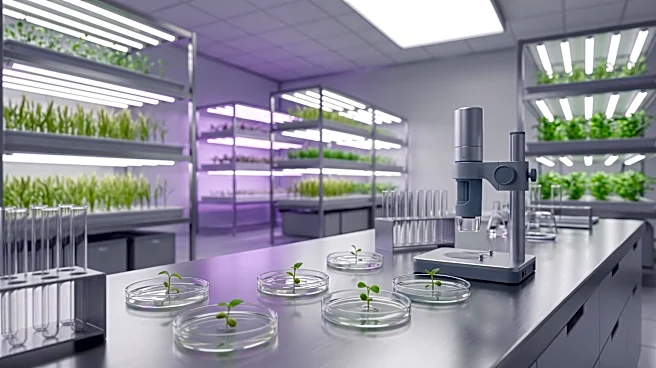
have released a joint vision titled 'A National Plant Breeding Strategy Must Work for Every Crop.' This initiative seeks to address the diverse needs of various crops, regions, and farmers. The groups emphasize that plant breeding is crucial for Canadian agriculture, as new crop varieties can take over a decade to develop from research to commercial production. These breeding programs are vital for creating varieties with improved pest and disease resistance, greater tolerance to changing weather conditions, enhanced productivity and quality, and the ability to meet evolving market demands. Public investment is deemed particularly important for crops where private investment may be limited due to market size or royalty returns, such as oats, food-grade soybeans, Eastern Canadian wheat and barley, Ontario-grown canola, and certain pulse crops.
Why It's Important?
While this initiative is Canadian, it holds significant implications for U.S. agriculture due to the integrated nature of North American agricultural markets and shared environmental challenges. A robust plant breeding strategy in Canada could lead to the development of new crop varieties that are more resilient to pests, diseases, and climate change, which could eventually benefit U.S. farmers through cross-border knowledge sharing and seed trade. The focus on public investment for crops with limited private-sector interest highlights a potential model for the U.S. to ensure the development of diverse and regionally adapted crops, rather than solely relying on commercially driven research. Furthermore, improved crop resilience and productivity in Canada could stabilize food supply chains across the continent, impacting food security and trade relations. The call for long-term, predictable funding underscores the critical need for sustained investment in agricultural research, a challenge also faced by U.S. agricultural institutions.
What's Next?
The Canadian farm groups are seeking renewed multi-year federal funding before the 2028 funding framework, as current Agriculture and Agri-Food Canada-supported breeding programs are scheduled to conclude in 2028. They are also advocating for the next AgriScience Program to support the entire variety-development process, especially for crops that receive limited private-sector investment. The organizations plan to continue discussions with Agriculture and Agri-Food Canada and other stakeholders to develop a comprehensive national strategy. This ongoing dialogue aims to create a framework that reflects Canada's diverse agricultural sector and ensures the long-term strength and resilience of its farming industry. The outcome of these discussions will determine the future trajectory of plant breeding research and development in Canada, potentially influencing agricultural policies and research priorities in neighboring countries like the U.S.
Beyond the Headlines
The push for a national plant breeding strategy in Canada reflects a deeper understanding of agriculture's long-term challenges, particularly in the face of climate change and evolving market demands. Beyond immediate crop improvements, sustained investment in plant breeding fosters scientific innovation and maintains a skilled workforce in agricultural research. This proactive approach to food security and environmental adaptation could serve as a blueprint for other nations, including the U.S., to re-evaluate their own agricultural research funding models. The emphasis on public funding for less commercially attractive crops also highlights a commitment to biodiversity and regional agricultural diversity, which are crucial for overall ecosystem health and resilience against widespread crop failures. This strategy acknowledges that a healthy agricultural sector is not solely about maximizing yields but also about building a sustainable and adaptable food system for the future.