




What's Happening?
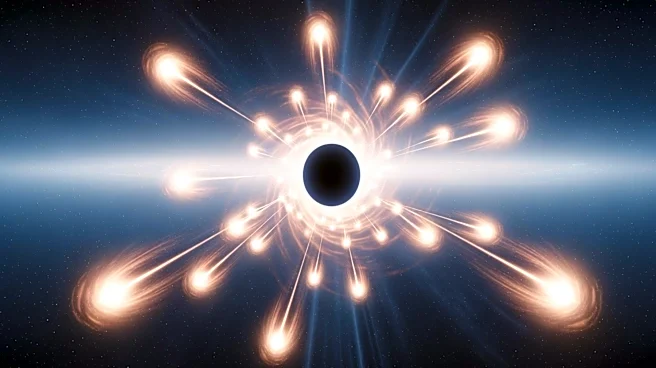
A recent study by an international team of scientists has provided new insights into the formation of massive black holes. Contrary to previous beliefs that these black holes form from the collapse of individual stars, the study suggests they result from repeated
mergers within dense star clusters. The research, conducted by Cardiff University, analyzed gravitational waves from 153 black hole merger events. The findings indicate that massive black holes exhibit chaotic rotation, a signature of multiple mergers in globular clusters, challenging existing models of stellar evolution.
Why It's Important?
This discovery has significant implications for our understanding of black hole formation and the dynamics of star clusters. It challenges traditional models of stellar evolution and suggests alternative pathways for black hole creation. The study's findings could lead to a reevaluation of how scientists interpret gravitational wave data and influence future research in astrophysics. Understanding black hole formation is crucial for comprehending the universe's structure and evolution, making this study a pivotal contribution to the field.