



What's Happening?
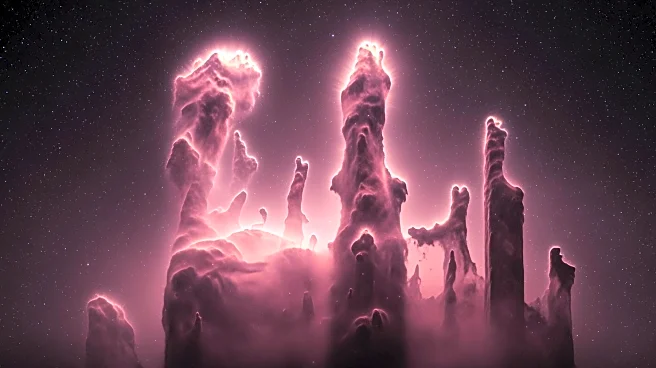
The James Webb Space Telescope has provided a mid-infrared view of the Pillars of Creation, located in the Eagle Nebula approximately 7,000 light-years away. This view allows scientists to focus on the dense dust within the star-forming regions of these
massive interstellar gas and dust trunks. The image is part of the 2025 Space Telescope Advent Calendar, showcasing the telescope's ability to capture detailed images of cosmic structures. The mid-infrared capabilities of the telescope enable researchers to study the composition and formation processes within these pillars, offering insights into the birth of stars and the evolution of galaxies.
Why It's Important?
The James Webb Space Telescope's observations are crucial for advancing our understanding of star formation and the lifecycle of cosmic structures. By examining the dense dust regions within the Pillars of Creation, scientists can gain insights into the processes that lead to star birth and the development of galaxies. This knowledge contributes to the broader field of astrophysics, helping to unravel the mysteries of the universe's origins and evolution. The telescope's ability to capture detailed images in mid-infrared wavelengths enhances our capacity to study regions that are otherwise obscured by dust, providing a clearer picture of the cosmos.