






What's Happening?
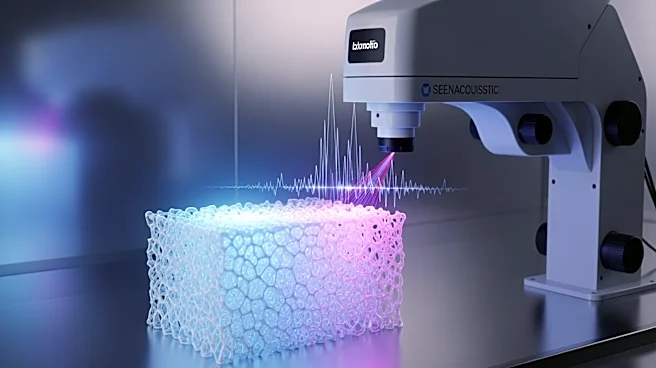
Recent advancements in precision medicine have been highlighted through the integration of 3D bioprinting and photoacoustic microscopy (PAM) to evaluate anti-cancer drug efficacy. This innovative approach involves creating bioprinted tumor-vessel models
that mimic the human tumor microenvironment. The study utilizes a custom-made high-resolution PAM system to investigate the effects of anti-cancer drugs on these models. By employing a pulsed laser for excitation, the system provides enhanced imaging depth and resolution, allowing for detailed observation of angiogenic responses and drug effects. The research demonstrates that this platform can effectively simulate tumor-induced angiogenesis and assess the impact of drugs like temozolomide and sunitinib, both individually and in combination, on vascular growth and tumor progression.
Why It's Important?
This development is significant as it offers a more physiologically relevant and scalable method for preclinical drug testing, potentially accelerating the development of personalized cancer therapies. By incorporating patient-derived cells into the bioprinted constructs, the platform allows for patient-specific drug testing, which could lead to more effective and tailored treatment options. The ability to visualize and quantify complex angiogenic responses in 3D provides a deeper understanding of drug interactions within the tumor microenvironment, which is crucial for developing new therapeutic strategies. This approach addresses limitations of current models by combining tissue-mimicking architecture with advanced imaging techniques, offering a promising tool for precision medicine.
What's Next?
Future applications of this technology could include expanding the use of patient-derived cells to create more personalized models for drug testing. Continued development of functional imaging techniques and advanced vascular modeling is expected to enhance the platform's capabilities. Researchers may also explore the integration of additional cell types and biomaterials to further mimic the complexity of human tissues. As the technology matures, it could become a standard tool in the drug development pipeline, providing more accurate predictions of clinical outcomes and reducing the reliance on animal models.
Beyond the Headlines
The ethical implications of using patient-derived cells in research highlight the importance of informed consent and data privacy. Additionally, the potential reduction in animal testing aligns with growing ethical concerns about animal welfare in scientific research. The long-term impact of this technology could lead to a paradigm shift in how cancer treatments are developed and tested, emphasizing the importance of personalized medicine and the need for regulatory frameworks to keep pace with technological advancements.