
What's Happening?
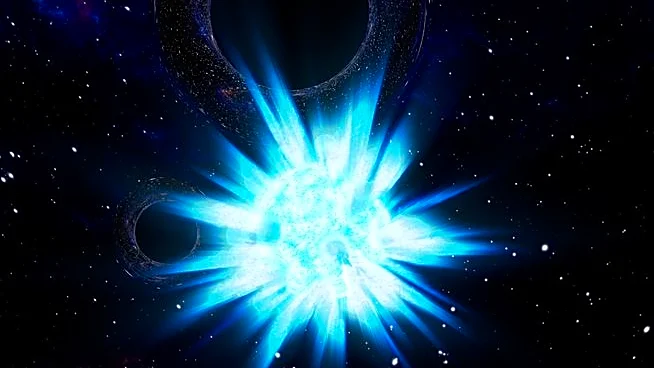
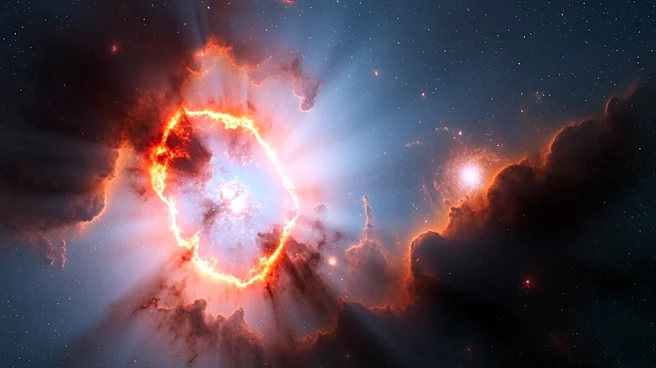
Astronomers have potentially observed a 'dirty fireball' star explosion for the first time, a phenomenon theorized since the 1990s. Using the Einstein Probe telescope, a powerful flash of X-rays was detected, suggesting a massive star's collapse and explosion.
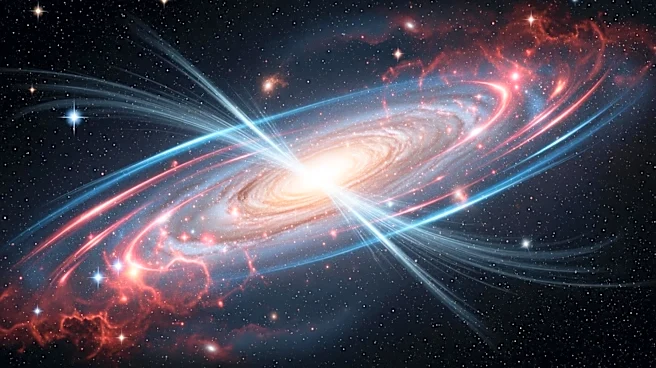
This event, different from typical gamma ray bursts, may involve a black hole or neutron star interacting with the jet, causing it to emit X-rays instead of gamma rays. The discovery could provide a more complete picture of black hole formation and the processes involved in massive star deaths.
Why It's Important?
This observation could significantly enhance our understanding of how massive stars die and the role of black holes in these processes. The 'dirty fireball' scenario, if confirmed, challenges existing models of star explosions and could reveal new aspects of stellar evolution. Understanding these explosions is crucial for astrophysics, as they are among the most powerful events in the universe, influencing galaxy formation and the distribution of elements. This discovery could lead to a reevaluation of how we observe and interpret cosmic phenomena.
What's Next?
Further analysis is needed to confirm the nature of the explosion and its distance from Earth. If validated, this could lead to more targeted searches for similar events, potentially uncovering a broader range of star explosion types. The findings may prompt revisions in theoretical models of star death and black hole formation. Continued observations with advanced telescopes could provide more data, helping to refine our understanding of these complex cosmic events and their implications for the universe.