
What's Happening?
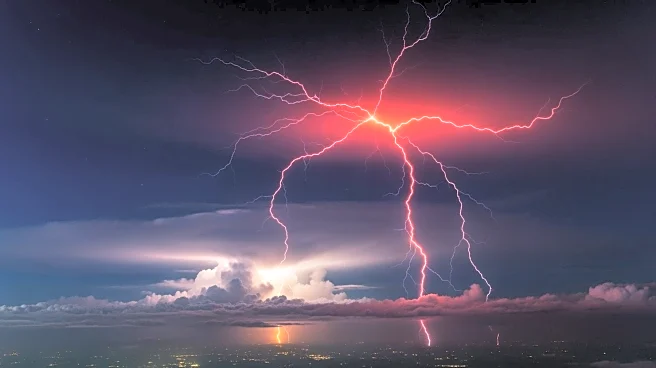
Astronaut Nichole Ayers aboard the International Space Station (ISS) has captured a rare atmospheric phenomenon known as a 'sprite' above a thunderstorm. This event, characterized by giant, glowing red tendrils,
was observed from 250 miles above Earth. Sprites are a type of electrical discharge that occur about 50 miles above the Earth's surface, triggered by intense lightning strikes within thunderstorms. Despite their striking appearance, the exact mechanisms behind their formation remain largely unknown. Sprites are part of a broader class of phenomena called Transient Luminous Events (TLEs), which also includes blue jets and elves. These events are difficult to observe from the ground due to their high altitude, making the ISS an ideal platform for capturing such phenomena.
Why It's Important?
The observation of sprites from space provides valuable data that cannot be obtained from ground-based observations. The ISS offers a clear and unobstructed view of the upper atmosphere, allowing scientists to study these rare phenomena in detail. Understanding sprites and their relationship to thunderstorms and lightning could enhance knowledge of atmospheric processes and improve weather prediction models. The data collected from such observations contribute to NASA's 'Spritacular' citizen science project, which encourages public participation in documenting TLE sightings. This research has implications for understanding global weather patterns and the electrical activity in the Earth's atmosphere.
What's Next?
Future research will continue to focus on understanding the mechanisms that trigger sprites and their role in atmospheric dynamics. Scientists aim to use data from the ISS and other space-based platforms to develop more comprehensive models of TLEs. The ongoing 'Spritacular' project will also benefit from continued public engagement and data collection, potentially leading to new discoveries about these elusive phenomena. As technology advances, more sophisticated instruments may be deployed to capture and analyze sprites, furthering scientific understanding of these atmospheric events.