


What's Happening?
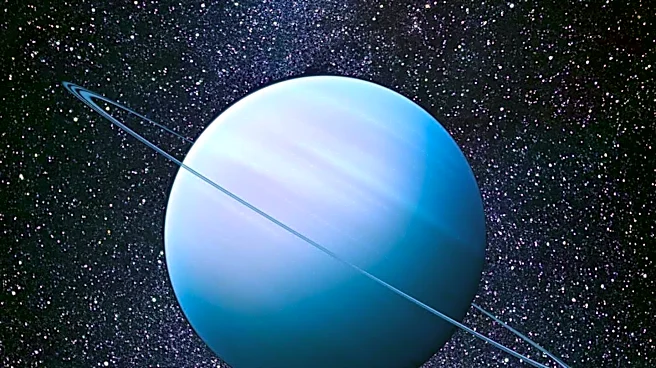
New research led by the Southwest Research Institute (SwRI) and published in The Planetary Science Journal investigates the interior composition and origins of Uranus and Neptune, the solar system's ice giants. The study focuses on measuring atmospheric
argon-40 to estimate the amount of rock beneath their surfaces and to uncover clues about their formation. Dr. Olivier Mousis, a planetary scientist at SwRI, led the research, which aimed to distinguish between argon-40 inherited from the protosolar nebula and argon-40 produced by radioactive decay within the planets. The team's simulations suggest that primordial argon from the protosolar nebula is more abundant than previously thought and would largely overshadow any contributions from internal radioactive decay. This indicates that atmospheric argon-40 measurements are more indicative of the planets' formation environments and history rather than their rocky or icy interiors.
Why It's Important?
This research is significant because it refines our understanding of how planets, particularly ice giants, form and evolve. By re-evaluating the role of argon-40, scientists can better interpret data from future planetary missions. The findings suggest that the materials forming argon-rich planets like Uranus and Neptune may have originated near an 'argon frost line' in the protosolar nebula, a region where low temperatures condensed argon gas into solid ice. This insight is crucial for reconstructing the early solar system's conditions and the chemical composition of planetary building blocks. Understanding these fundamental aspects of planetary formation helps to contextualize our own solar system's history and provides a framework for studying exoplanets, contributing to the broader field of astrobiology and planetary science.
What's Next?
The study's findings will guide future missions to Uranus and Neptune, such as the proposed NASA Uranus Orbiter and Probe mission concept. These missions could be equipped with advanced mass spectrometers capable of directly sampling noble gases and isotopic ratios in the planets' atmospheres. Such direct measurements would provide critical data to validate or refine the current theories about the ice giants' formation. Researchers also plan to analyze other atmospheric components like nitrogen and carbon, which could further illuminate the formation mechanisms of these distant planets. Continued exploration and data collection are essential to definitively answer long-standing questions about the composition and origins of Uranus and Neptune.
Beyond the Headlines
The research delves into the intricate processes of planet formation, highlighting how subtle chemical signatures from the early solar system can persist for billions of years. This work underscores the importance of isotopic analysis as a powerful tool in planetary science, allowing scientists to peer back in time to the conditions that shaped our cosmic neighborhood. The concept of an 'argon frost line' adds another layer of complexity to models of protoplanetary disks, suggesting specific regions where certain elements would condense, influencing the composition of forming planets. This could have broader implications for understanding the diversity of planetary systems observed throughout the galaxy, potentially revealing commonalities or unique characteristics in the formation of gas and ice giants across different stellar environments.