


What's Happening?
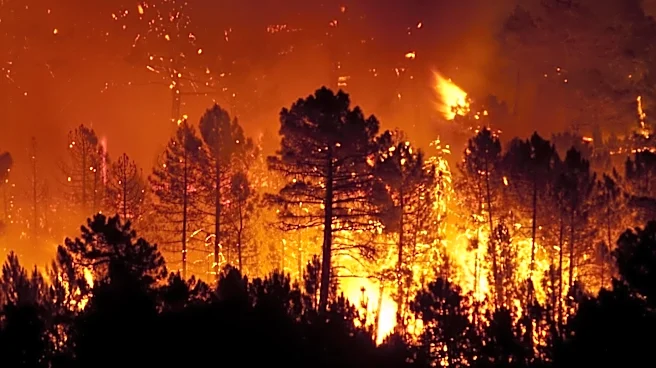
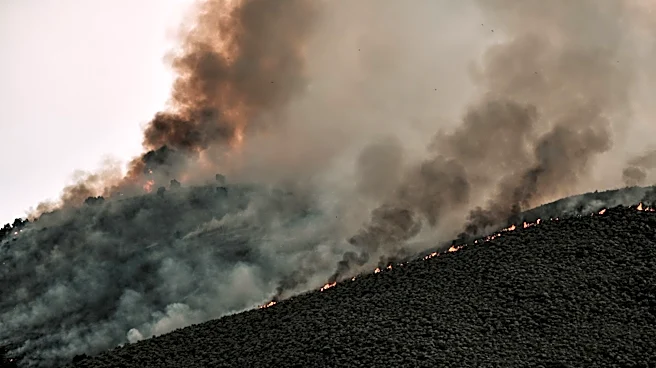
A vegetation fire, named the Hawk Fire, originating in Washoe County, Nevada, has prompted evacuation warnings for parts of Sierra County, California. The fire, burning northeast of Verdi, has already consumed over 10,500 acres and is threatening nearly
1,000 structures, according to the U.S. Forest Service. Sierra County Sheriff's Office has issued evacuation warnings for zones E024 and E061, which encompass the Verdi and Long Valley areas in eastern Sierra County. Residents in these zones are advised to be prepared to leave their homes if necessary. Additionally, the fire has caused a power outage for 14,800 customers in the Truckee area, as NV Energy de-energized a transmission line due to its proximity to the Hawk Fire.
Why It's Important?
This incident highlights the cross-state impact of wildfires, where a fire starting in one state can directly threaten communities and infrastructure in an adjacent state. For California, a state frequently battling large-scale wildfires, this event underscores the continuous threat posed by such blazes, regardless of their origin. The issuance of evacuation warnings signifies a direct risk to residents and their properties, leading to potential displacement and disruption of daily life. The power outage affecting thousands of customers in Truckee further illustrates the broader economic and societal consequences, impacting businesses and essential services. This situation emphasizes the critical need for inter-state cooperation and coordinated emergency response efforts in managing and mitigating wildfire threats across state lines.
What's Next?
Authorities are actively monitoring the Hawk Fire and its progression. Residents in the warned Sierra County zones should remain vigilant and prepared for potential mandatory evacuation orders. Firefighting efforts will continue, focusing on containment and protecting threatened structures. The power utility, NV Energy, will likely work to restore power to the affected Truckee customers once it is safe to do so, depending on the fire's behavior and proximity to the transmission lines. The U.S. Forest Service and local fire departments will continue to provide updates on the fire's status, containment levels, and any changes to evacuation orders or warnings. The investigation into the cause of the Hawk Fire will also likely commence once the immediate threat is managed.
Beyond the Headlines
The Hawk Fire exemplifies the increasing challenge of managing wildfires in the Western U.S., where dry conditions and strong winds can quickly escalate a local fire into a regional crisis. The interconnectedness of infrastructure, such as power grids, means that a fire in one area can have cascading effects on distant communities. This event also brings to the forefront the psychological burden on residents living in fire-prone areas, who must constantly live with the threat of evacuation and potential loss. It underscores the long-term implications of climate patterns on wildfire frequency and intensity, prompting ongoing discussions about land management practices, forest health, and community preparedness strategies to build resilience against these recurring natural disasters.