







What's Happening?
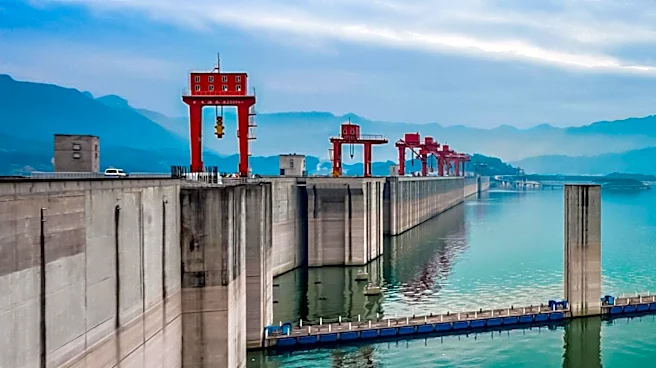
A recent study published in Frontiers in Marine Science, analyzing sediment cores from the northern South China Sea, reveals that large-scale dam and reservoir construction in China since 1950 has profoundly altered sediment flow, overriding natural monsoon-driven
patterns. For the first two centuries of the 250-year record (1750-1920s), sediment composition was primarily influenced by the East Asian Summer Monsoon. However, after 1950, despite a weakening monsoon, the sediment on the Pearl River shelf became progressively coarser. This 'proxy decoupling' indicates that human policy decisions, specifically dam construction, are now the dominant factor. Dams trap fine-grained particles, leading to downstream erosion and a coarser sediment supply reaching the sea. This finding challenges the reliability of single-proxy paleoclimate studies in the region post-1950, emphasizing the need for multi-proxy approaches to differentiate between climate and anthropogenic influences.
Why It's Important?
This shift in sediment dynamics has critical implications for the highly productive marine ecosystems of the northern South China Sea. Benthic communities, fisheries, and shallow-water reef systems rely on a balanced sediment budget. Reduced delivery of fine-grained material changes the chemistry, texture, and fertility of seafloor sediments, directly affecting the organisms that inhabit these areas. Furthermore, deltas, including the Pearl River Delta which is home to millions, face increased erosion as sediment supply dwindles, making them more vulnerable to sea-level rise and storm surges. The study highlights a significant environmental consequence of large-scale infrastructure projects, demonstrating how human activities can fundamentally alter natural processes on a regional scale, with long-term ecological and socio-economic impacts.
What's Next?
The study's authors recommend that future research in the northern South China Sea and Taiwan Strait adopt a multi-proxy approach when analyzing sediment archives from the mid-20th century onward. This will be crucial for accurately distinguishing between climate-driven changes and the impacts of human engineering. Further mapping of the spatial gradient of sediment reduction will be necessary to understand the uniformity of the dam-driven signal across the broader shelf. Coastal communities and environmental agencies in the region will need to consider these altered sediment dynamics in their planning for coastal protection, fisheries management, and ecosystem conservation efforts, especially given projections of continued sediment starvation in areas like the Pearl River's coastal zone.
Beyond the Headlines
The findings underscore a broader ethical and scientific challenge: how to accurately interpret environmental records in an era dominated by human impact. The 'proxy decoupling' observed in the South China Sea sediment cores serves as a stark reminder that natural climate signals can be masked or entirely overwritten by anthropogenic activities. This raises questions about the baseline for 'natural' environmental conditions and the methodologies used to reconstruct past climates, particularly in heavily developed regions. It also highlights the interconnectedness of terrestrial and marine environments, where upstream land-use decisions have profound and lasting effects on distant ocean ecosystems, necessitating a more integrated approach to environmental management and policy.