
What's Happening?
Former Illinois Governor Rod Blagojevich appeared on Fox News, where he criticized Michigan Senate candidate Abdul El-Sayed, a Democrat, for allegedly lacking understanding of 'what real men know.' Blagojevich's
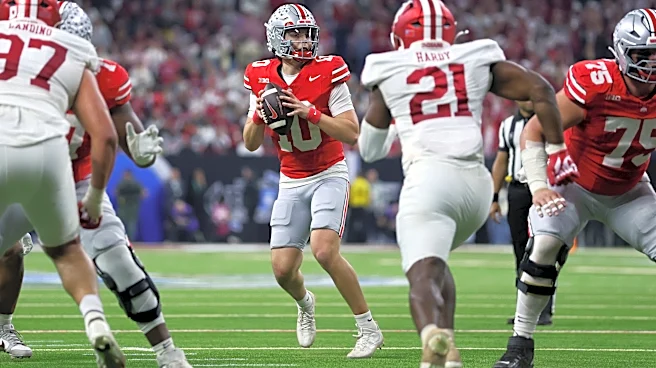
comments were made in response to a 2023 clip of El-Sayed questioning the U.S. as the 'land of opportunity' and suggesting Canada might be better for the 'American dream.' Blagojevich specifically attacked El-Sayed's college football knowledge, claiming El-Sayed didn't know that 'Ohio' refers to 'Ohio State' in the context of the Michigan-Ohio State rivalry. He further asserted that Democratic candidates like El-Sayed are inauthentic and lack 'testicular virility' for allegedly using terms like 'birthing persons' instead of 'mother, mom or mama.' The article refutes Blagojevich's claims, noting that Michigan fans commonly refer to Ohio State as 'Ohio' and that El-Sayed has been shown using 'mama' in a Mother's Day video. The article also highlights Blagojevich's past corruption conviction and subsequent pardon by President Trump.
Why It's Important?
This incident is important as it exemplifies the highly polarized and often personal nature of political discourse in the U.S., particularly on cable news. The use of inflammatory language and personal attacks, rather than substantive policy debate, can distract from critical issues and further entrench partisan divisions. Blagojevich's comments, which were quickly debunked by the article, illustrate how misinformation and mischaracterizations can be propagated in political discussions. Furthermore, the focus on perceived 'masculinity' and 'authenticity' in political candidates, as opposed to their qualifications or policy positions, reflects a broader trend in some segments of political commentary. The involvement of a figure like Blagojevich, who has a controversial past, also raises questions about the credibility and motivations of those participating in such discussions, potentially influencing public perception of both the candidates and the media outlets involved.
What's Next?
The immediate impact of such comments is likely to be continued debate and criticism within political and media circles. Abdul El-Sayed's campaign may choose to address or dismiss these remarks, potentially using them to highlight the perceived negativity of his opponents. For Rod Blagojevich, this appearance reinforces his role as a controversial political commentator, often engaging in provocative statements. The broader implication is that this type of rhetoric will likely persist, especially as the Michigan Senate race intensifies. Voters will continue to be exposed to a mix of policy discussions and personal attacks, requiring them to critically evaluate the information presented. This incident also serves as a reminder of the ongoing challenge for media outlets to maintain factual accuracy and avoid amplifying unsubstantiated claims in political reporting.
Beyond the Headlines
Beyond the immediate political sparring, this event touches on deeper cultural and societal anxieties, particularly around gender roles and traditional values in a rapidly changing political landscape. Blagojevich's remarks about 'real men' and 'birthing persons' tap into a broader cultural debate about identity, language, and perceived threats to traditional norms. This type of rhetoric often resonates with certain segments of the electorate who feel disenfranchised or believe their values are under attack. The incident also highlights the phenomenon of 'political entertainment,' where figures with controversial pasts are given platforms to engage in highly charged discussions, often prioritizing spectacle over substance. This can contribute to a political environment where emotional appeals and personal attacks overshadow reasoned debate, potentially impacting civic engagement and trust in institutions.